Paoli | Sep 20-21, 1777
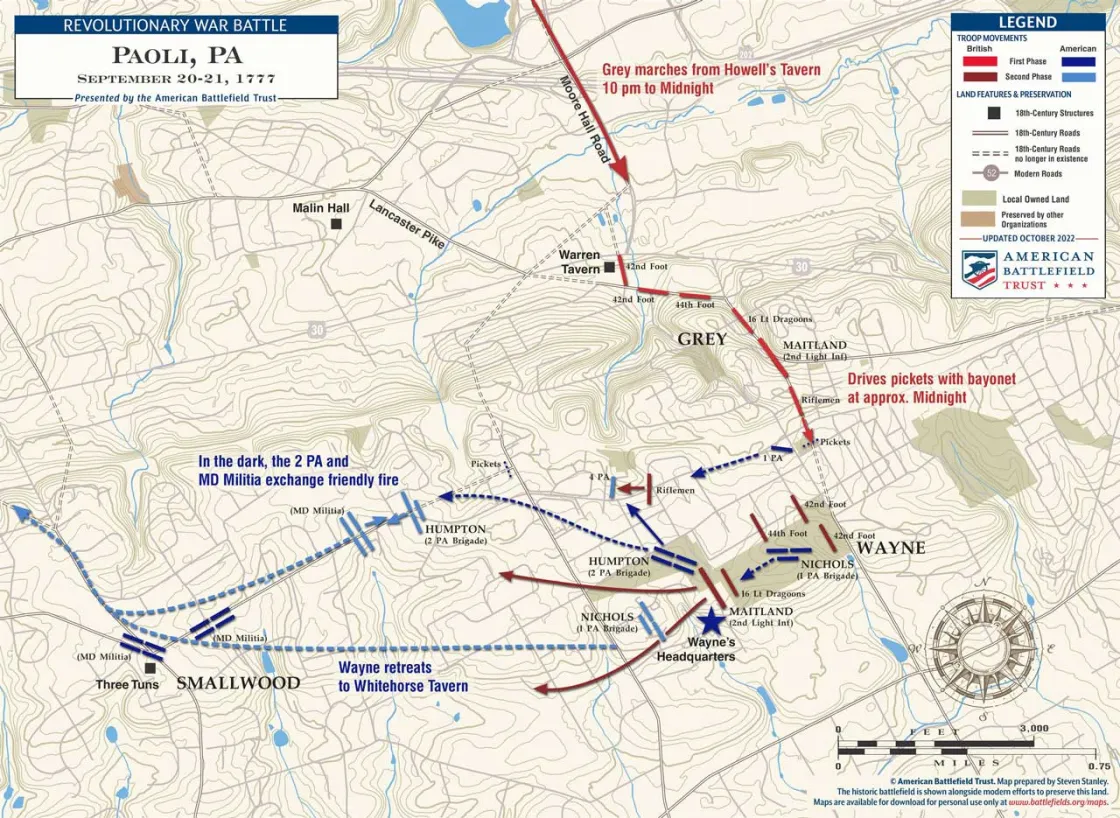
On the night of September 20, 1777, one of the most infamous events of the American Revolution occurred: the Battle of Paoli, also known as the Paoli Massacre. Though only 53 Americans were killed in the nighttime British surprise attack, Patriot propagandists seized on the episode, vilifying British tactics as soldiers were cut down with bayonets.
After the American defeat on September 11 at Brandywine Creek, British General Sir William Howe’s forces occupied the American capital at Philadelphia. General George Washington needed to keep his army close to the city to monitor British movements. At the same time, the Continental Army was chronically short of provisions and required access to supply depots at Reading, Pennsylvania. To balance these needs, Washington positioned his forces between Philadelphia and Reading—about fifty miles to the northwest—dividing his army and posting units on both sides of the Schuylkill River just north of the city.
He ordered General “Mad” Anthony Wayne, encamped near Chester, Pennsylvania, to harass British forces and attempt to disrupt their supply lines. Wayne, however, mistakenly believed his position had gone undetected—an oversight that would prove costly.
British intelligence soon located Wayne’s camp near the General Paoli Tavern, in present-day Malvern, Pennsylvania. Wayne further exposed his position by leaving his camp insufficiently secured. On the night of September 20, British troops under General Charles Grey advanced on the unsuspecting Americans. To ensure complete surprise, Grey ordered his men to unload their muskets and remove their flints, relying instead on the bayonet.
Grey’s men struck with devastating effect, emerging from the woods and catching the Americans off guard. Panic spread through the camp as British Regulars overran and destroyed it. Wayne’s division was routed, suffering roughly 272 casualties. For his tactics that night, Grey earned the nickname “No Flint” Grey.
In the aftermath, Wayne faced court-martial on charges of misconduct. Though cleared of wrongdoing, the court found that he had committed a tactical error in the deployment of his troops. Wayne himself pressed for a full inquiry to clear his name, and the court ultimately concluded that he had acted with honor.
Accounts from American soldiers helped fuel Patriot outrage, claiming that British troops offered no quarter as men attempted to surrender—further cementing the event’s reputation as a “massacre.”
Wayne would later take his revenge at Stony Point, New York, urging his men forward with the cry, “Remember Paoli,” and returning the favor against the British.
Related Battles
272
11