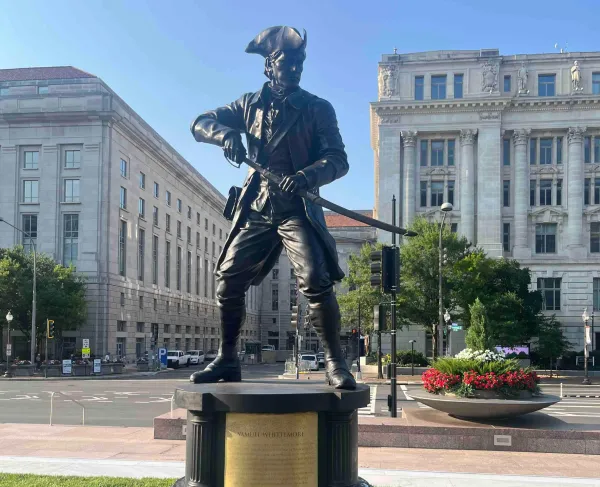
Stephen Hopkins
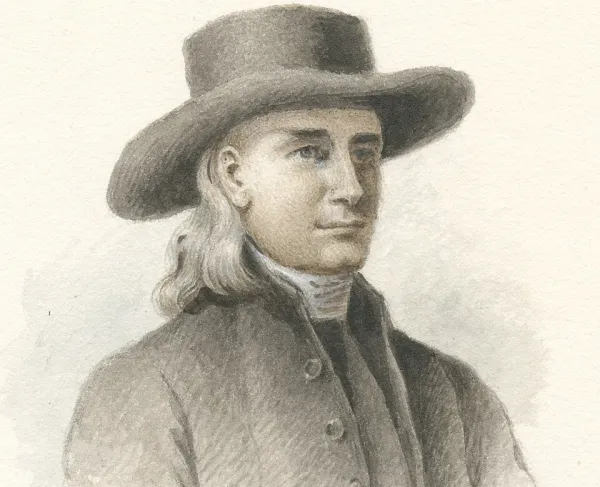
Rhode Islander Stephen Hopkins played a pivotal role in the American Revolution. He was a jurist, legislator, state governor, and a signer of the Declaration of Independence. Afflicted with Parkinson’s disease, Hopkins’ hand was shaking when he added his name to that hallowed document, but he assured his fellow patriots of his resolve, declaring “my hands may tremble, my heart does not."
Hopkins was born in Providence, Rhode Island, on March 7, 1707, to prominent, but not wealthy, descendants of the colony’s original settlers. He was raised on his family’s farm in Scituate, where his mother and grandfather tutored him in the English classics and mathematics. Despite having had no formal education, the young Hopkins became a surveyor and an astronomer, but his high standing in the community ultimately set him on the path to politics. He was in his early twenties when the residents of Scituate selected him to moderate its town meeting. He soon became the town clerk, then took on the presidency of the town council. Hopkins was chosen to represent Scituate in Rhode Island’s General Assembly from 1732 to 1741 and moved to Providence in 1742. There, he worked with his brother, Esek Hopkins, as a ship merchant and built an iron foundry that would later supply cannons to the Patriot army. Esek served as commander-in-chief of the Continental Navy during the Revolutionary War.
Without ever earning a law degree, Hopkins was appointed in 1747 to the colony’s Supreme Court and became chief justice in 1751. By 1755 he won the governorship of Rhode Island and served as governor several times over the next ten years, beating his noted political rival Samuel Ward on many occasions. In 1774, both Ward and Hopkins were chosen to represent Rhode Island in the First Continental Congress. At 68, Hopkins was the second oldest member of the Congress, being a year younger than his colleague Benjamin Franklin.
Hopkins was a vocal critic of Great Britain’s policies toward the American colonies. During the Stamp Act crisis, he wrote a pamphlet entitled “The Rights of Colonies Examined,” in which he attacked both the Sugar Act and the Stamp tax. His text embraced the ideal of liberty, calling it “the greatest blessing that men enjoy,” and comparing it to slavery which he pronounced “the heaviest curse that human nature is capable of,” although Hopkins was a slave owner.
As Chief Justice of the Rhode Island Supreme Court, Hopkins became embroiled in the first violent act of resistance to the British Crown in the colonies during the Gaspee Affair of 1772. When the British customs ship Gaspee, which the colonists saw as a threat to local trade, ran aground off Warwick, Rhode Island, a group of local patriots boarded the vessel, captured the captain, evacuated the crew, and set the schooner on fire. Hopkins was pressured by the Crown to reveal the names of the men involved and bring them to justice, but the staunch patriot never did so.
By 1774, Hopkins believed that war with the Crown was inevitable and told his fellow delegates: “The gun and bayonet alone will finish the contest in which we are engaged, and any of you who cannot bring your minds to this mode of adjusting the quarrel, had better retire in time.” In 1776, he signed the Declaration of Independence. Hopkins later helped to draft the Articles of Confederation, but his failing health compelled him to return to Rhode Island soon afterward. He died in Providence on July 13, 1785, and is buried there in the North Burial Ground. In addition to his service as a statesman, the self-educated Rhode Islander was instrumental in the establishment of what is now Brown University and served as Brown's first chancellor from 1764 to 1785.