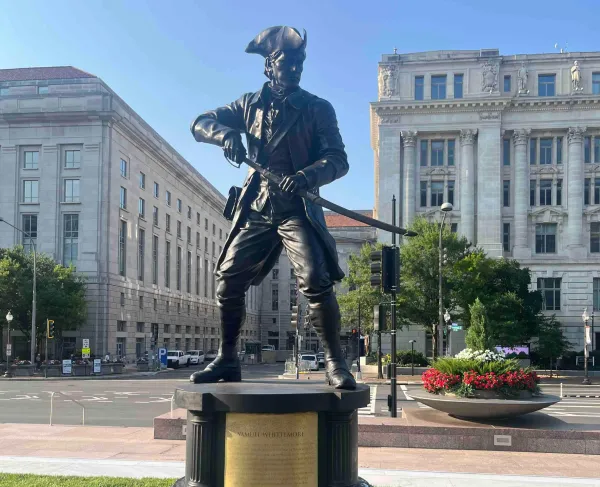
Silas Talbot
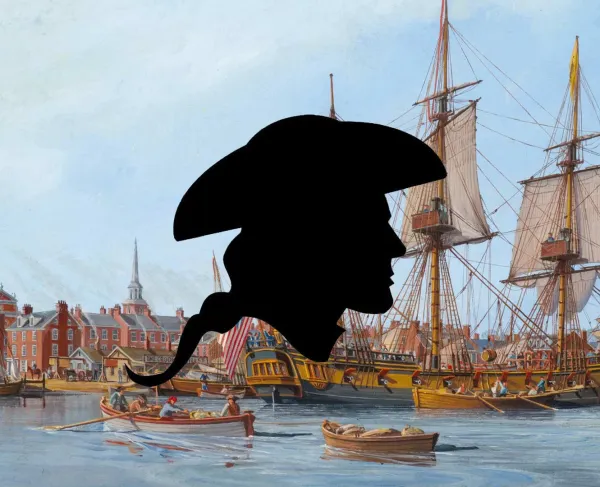
During the Revolutionary War, Silas Talbot applied his many talents to the Patriot war effort, serving as artisan, entrepreneur, privateer, Rhode Island Militia officer, Continental Army officer, and Continental Navy officer. His diverse abilities were assets in the ever-changing and perilous fortunes of war, and his skills proved invaluable in the Battle of Rhode Island and the subsequent capture of the British schooner Pigot in 1778.
Born in Dighton, Massachusetts, in 1751, Talbot had little formal education but taught himself the trades of mariner and builder. In 1772, he married the daughter of a prominent Rhode Island merchant, entered Providence society, and established himself in the mercantile business. With tensions escalating between the American colonies and Great Britain after the burning of the Gaspee and the Boston Tea Party, the successful entrepreneur joined the Rhode Island militia and, due to his high standing in the community, was commissioned as a lieutenant. On June 28, 1775, Talbot answered the Rhode Island Assembly’s call to send units to Boston to engage British troops. He marched with his men to join the Second Rhode Island Regiment, and by July 1, he was commissioned a captain. Talbot and the other 1200 men in the Rhode Island brigade took part in the Siege of Boston, but did not engage in direct combat.
By April 1776, after the siege ended, Esek Hopkins, a Rhode Islander and Commander in Chief of the Continental Navy, was looking for a way to move his battered ships from New London harbor to Providence. But Hopkins had no crew. When George Washington offered to loan Hopkins men from the Rhode Island Regiment, Silas Talbot took the opportunity to sail home, switching his service from the army to the navy. It was the first of several career changes he would make as opportunities presented themselves throughout the war years. Talbot successfully escorted the boats home, then sailed with Rhode Island troops to confront the British navy in New York. In September 1776, he helped create and launch a combustible “fireship” to set British vessels near Manhattan on fire, a risky act which left him severely burned.
In the summer of 1778 Talbot played a critical role in the Battle of Rhode Island. With his experience as a mariner and builder, he helped construct the flatboats that would take American forces to Portsmouth on August 9th of 1778 in anticipation of an assault against the British. Talbot then pivoted and fought in the rear guard to protect the Patriots as they retreated to Tiverton on August 29 and 30, 1778. Right after the Battle of Rhode Island, he became instrumental in a Patriot plan to remove a British schooner, Pigot, that had been blocking Narragansett Bay. Talbot agreed to again serve the American cause, but this time he did so for profit as a privateer. On the night of October 28, 1778, Silas’s ship, the Hawke, sailed from the Taunton River to the Sakonnet River. The sentries at the Fogland Batteries did not see her. When the Hawke got within sight of the Pigot, Talbot positioned his craft so he could ram his boat through the Pigot’s protective netting. The crew of the Hawke boarded and captured the British vessel and, encountering little resistance, sailed the Pigot to Stonington, Connecticut.
After the war, Talbot settled in Johnstown, New York. He was a member of the New York State Assembly in 1792 and 1793 and served in the United States House of Representatives from 1793 to 1795. In 1797, Talbot supervised the building of the USS Constitution, "Old Ironsides," at the Charlestown Navy Yard in Boston, Massachusetts. He served as commander of that vessel from 1799 until his retirement from the Navy in 1801. Talbot died in New York City on June 30, 1813, and was buried in Trinity Churchyard in lower Manhattan.

Related Battles
181
260