Alfred Waud
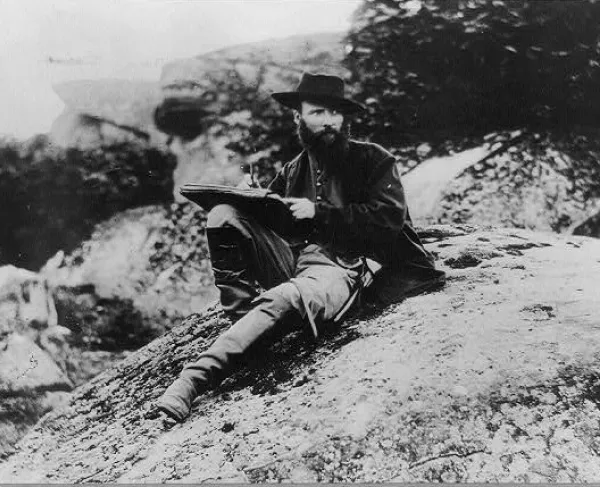
Alfred Rudolph Waud was born on October 2, 1828 in London, England. He was the eldest son of Alfred Waud, Sr., and Mary Fitz-John, who had five children total. When Alfred Jr. was a young man, he entered the Government School of Design at Somerset House, London with the goal of becoming a marine painter. This plan would not come to fruition, but as a student he worked in theatrical scenery – something he intended to pursue in the United States.
In 1850 at the age of 22, Waud boarded the sailing ship Henrik Hudson bound for New York. Shortly after his arrival, he began working for a Boston humor magazine by the name of The Carpet Bag and provided illustrations for several books, most notably Hunter’s Panoramic Guide from Niagara to Quebec which was published in 1857. In 1855, Waud met and married Mary Gertrude Jewell of New York. They lived and raised their four children in Orange, New Jersey.
In 1860, Waud began working for the New York Illustrated News as a staff illustrator. When the Civil War began the following year, he was given the assignment of covering the Army of the Potomac. Entering the field with the army, Waud was able to produce on the spot sketches of battles that were then printed as engravings. Though he joined Harper’s Weekly at the end of the year, Waud continued covering the Army of the Potomac – seeing every action from the First Battle of Bull Run in 1861 to the Siege of Petersburg in 1865. He was one two artists present at the Battle of Gettysburg and his depiction of Pickett’s Charge is an excellent eyewitness account.
After the war, Waud continued to contribute to Harper’s Weekly as he documented American life in a wide variety from the Reconstruction era south to the growing western frontier. He did not work solely for Harper’s, he also was a freelance illustrator contributing to many publications. One of the most notable contributions was to Picturesque America published in multiple volumes from 1872 – 74. Also in 1870, he was naturalized as an American citizen.
The 1890’s was called the Golden Age of Battlefield Preservation when the first national battlefield parks were created. In 1891, Alfred Waud was touring battlefields in the south when he passed away in Marietta, Georgia at the age of 62.