Julian Scott
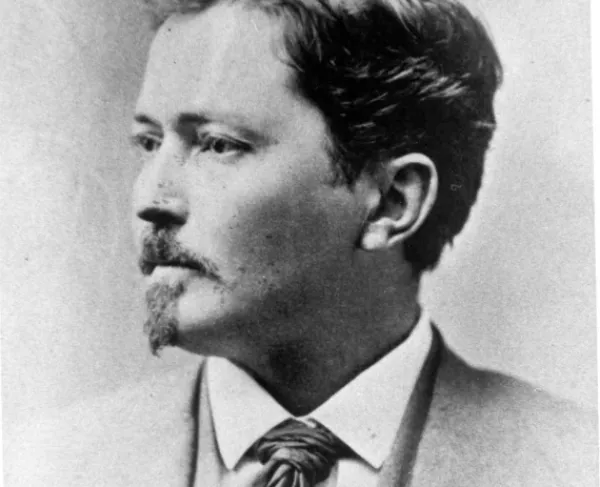
Julian Scott was born in Johnson, Vermont, on February 15, 1846. He was the fourth of eight children. Scott turned 15 only a couple of months before the Civil War began. He enlisted in the 3rd Vermont Infantry on June 1, 1861, following his three older brothers who had already joined the service. At such a young age, Scott had a slight frame, so he was assigned to be a drummer and fifer.
Scott is best remembered for his actions at the Battle of Lee’s Mill. Part of General George B. McClellan’s Siege of Yorktown, the Battle of Lee’s Mill saw Union troops attempt to get past fortified Confederate defenses. Union troops tried to cross the creeks and rivers but were unsuccessful under heavy Confederate fire. Scott assumed the role of a medic, a common and expected role of fifers, drummers, and other musicians during the Civil War. He crossed the creek multiple times to rescue other soldiers, ultimately saving at least nine. For his heroic actions at the Battle of Lee’s Mill, Scott was awarded the Medal of Honor in February 1865, the first Vermonter to earn it. His recommendation, written by Lt. Col. Wheelock G. Veazey, reads, “Crossed the creek under a terrific fire of musketry several times to assist in bringing off the wounded.”
Scott’s military career ended when he was wounded during the Battle of White Oak Swamp. He stayed at a hospital in Long Island Sound. During his stay at the hospital, he spent much of his time drawing. Scott had a propensity for art from a young age. He attended the Lamoille Academy in his early years and painted signs to help his father’s business. A benefactor of the hospital named Henry E. Clark saw his work and funded some of Scott’s future studies, allowing him to continue his art career.
Although no longer a soldier, Scott returned to the battlefield in 1864 and 1865, recording battlefields and other military subjects. Key to Scott’s Civil War art is his propensity to put the common soldier front and center, rather than high-ranking officers. After the war, Scott travelled to Europe and studied under famed German American artist Emanuel Leutze, best known for his painting Washington Crossing the Delaware (1851).
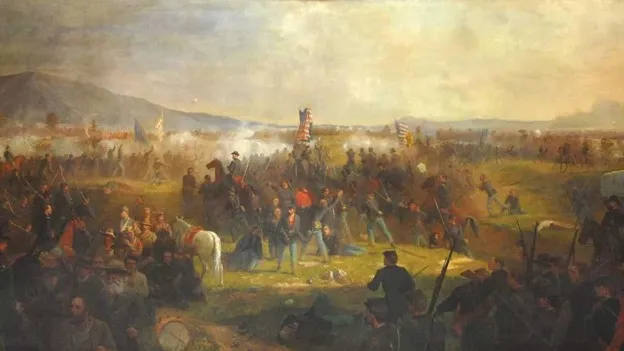
Scott was commissioned to paint one of his most well-known paintings, The Battle of Cedar Creek, by the Vermont Legislature in 1870. Many Vermont regiments had served in the battle, and Scott was a Vermont native, so the commission worked to honor all Vermonters who had served in the Civil War. Scott took two years to complete the painting, and only made $400 from the endeavor, the other $8,600 he received from the Vermont Legislature going to the painting.
Later in his career, Scott was hired to be a special agent of the U.S. Census in the 1890s. This census was significant because it was the first American census to include Native Americans as Americans. That is why Scott and other famous artists of his day were sent to the American West to not only count how many Native Americans were living in the region but also paint portraits of them. One such well-known painting of his was Sitting Bull (N.D.). After his adventures out West, Scott moved back to the east coast, where he died on July 4, 1901, and was buried in Scotch Plains, New Jersey.

Related Battles
165
75