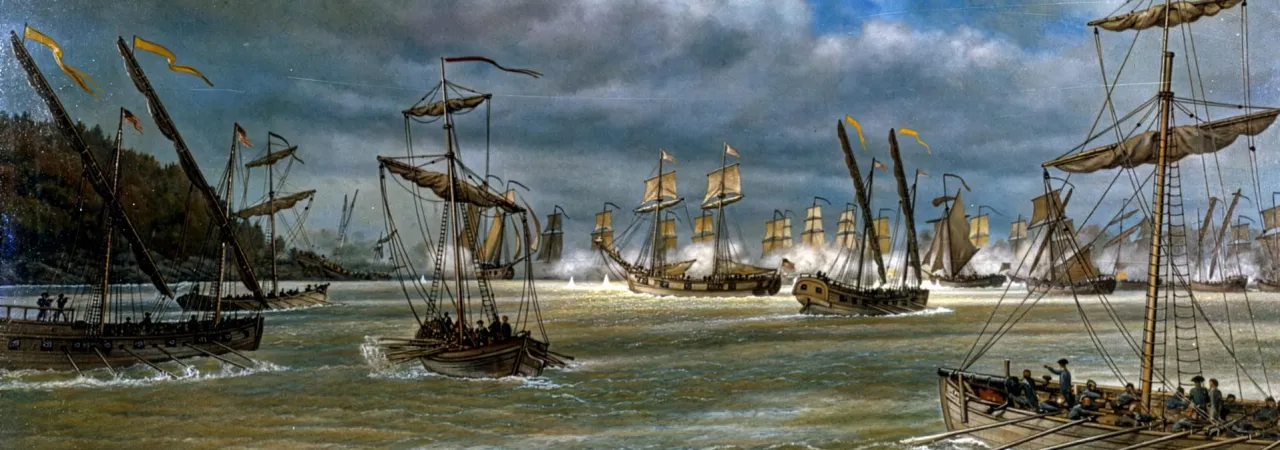
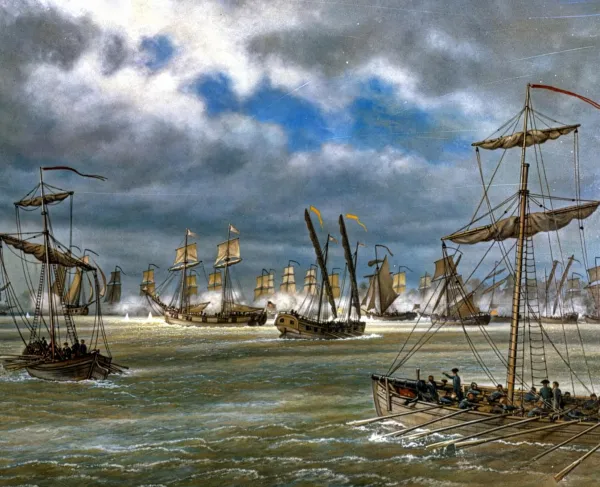
Battle of Valcour Island, by V. Zveg, date unknown. The painting depicts the naval engagement between American and British forces on Lake Champlain on October 11, 1776.
Did you know that one of the first widely recognized naval battles fought by the United States occurred not at sea, but on Lake Champlain, on the border between New York and Vermont?
The Battle of Valcour Island, sometimes referred to as the Battle of Valcour Bay, occurred on October 11, 1776. Brigadier General Benedict Arnold, a talented soldier but untrained seaman, led a stopgap fleet of American ships against the similarly trained General Guy Carleton, who commanded a force that included elements from the British Royal Navy.
After a failed invasion into Canada in 1775, Arnold retreated with his troops to the southern end of Lake Champlain. There, in July 1776, he convened a council of war, petitioning for the assembly of a naval force that could defend against British forces. Arnold knew what the British were setting their sights on: Lake Champlain and the upper Hudson River Valley were central to colonial trade, providing shipping alternatives to nearly impassable overland routes. This region also connected the New England colonies — where most of the revolutionary fervor was seen to rest — to those farther south. If British forces secured control, they could effectively sever communication and trade between the colonies, picking off rebellious colonies one by one rather than fighting a united force.
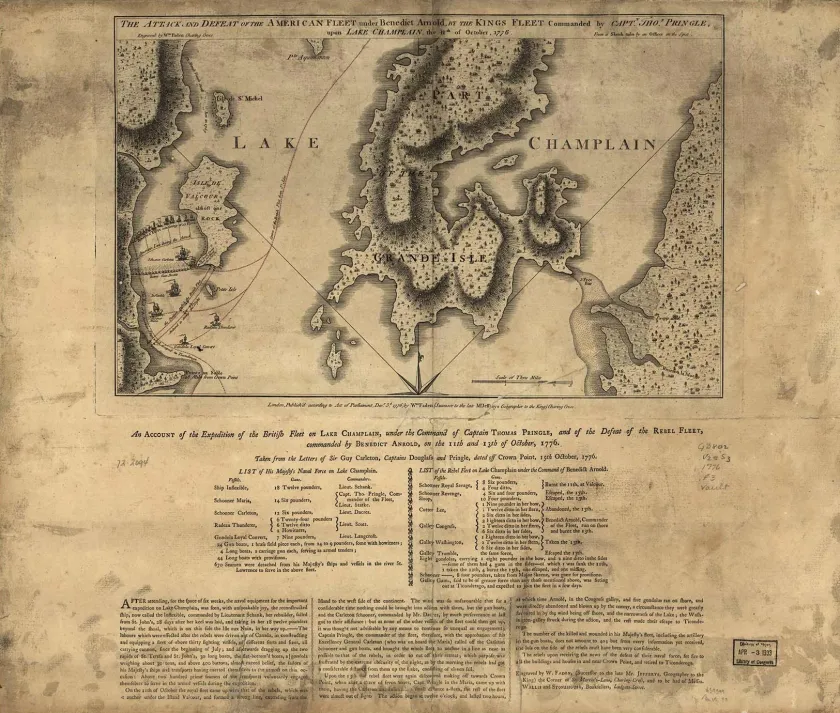
The Attack and Defeat of the American Fleet under Benedict Arnold, engraved by William Faden, 1776. The map depicts the Battle of Valcour Island on Lake Champlain on October 11, 1776.
Library of CongressSo, Arnold’s wish for ships was granted. Construction efforts commenced at Fort Crown Point on Lake Champlain, originally built in 1759 by British and colonial troops to defend against the French. By October of 1776, a small American naval force of about 17 ships and approximately 500 men was fashioned. This fleet began with four ships, Royal Savage, Revenge, Liberty and Enterprise, and was then joined by the cutter Lee, the gunboats New Haven, Providence, Boston, Spitfire, Philadelphia, Connecticut, Jersey and New York and three row-galleys, the Trumbull, Washington and Congress, Arnold’s new flagship.
The British force was comprised of roughly 1,300 men, including both trained seamen and Native Americans. The Royal Navy fleet boasted 30 vessels, including the flagship HMS Inflexible, the schooners HMS Maria, HMS Carleton, HMS Royal Convert and the ketch HMS Thunderer, as well as more than 20 gunboats.
American forces sustained heavy damage from cannon fire throughout October 11. Revenge was heavily hit and abandoned. Philadelphia sank around 6:30 p.m., roughly six hours into the battle. Royal Savage ran aground. Congress, Washington, Jersey and New York were also all badly hit. The Americans had suffered 60 casualities; the British about 40. As Arnold surveyed the remaining forces, it appeared the only option was to escape.
Led by Trumbull, the American fleet slipped through the British line undetected in the darkness of October 11–12. By morning, the Americans were nearly eight miles away, stopping only to burn more of their remaining ships too damaged to continue.
But by the morning of October 13, Carleton’s fleet caught up with the Americans and confronted the remaining forces near Split Rock. Washington was captured. Congress sank. Arnold then ordered that the rest of his fleet be run aground. The Americans stripped and burned their ships, and Arnold led about 200 men on foot back to Crown Point, where they burned whatever remained there as well.
The Americans continued to Fort Ticonderoga as the British established their position at Crown Point. With winter approaching and the fort and stores burned days prior by the American forces, British plans to invade the region were delayed.
The Gunboat Philadelphia
For 159 years, Philadelphia, one of the many vessels lost in the battle, sat on the bottom of Lake Champlain, exactly where she fell. It was not until 1935 that a civil engineer named Lorenzo Hagglund discovered the gunboat’s remains, and Philadelphia left Lake Champlain’s icy waters.
While she was small for a war vessel, spanning only 54 feet and weighing 29 tons compared to the flagship Congress’s 129-foot length, resting untouched on the cold, dark lake bottom had left her in remarkable condition. On the boat was evidence of cannon fire, including a 24-pound cannon ball still lodged in the portside planking.
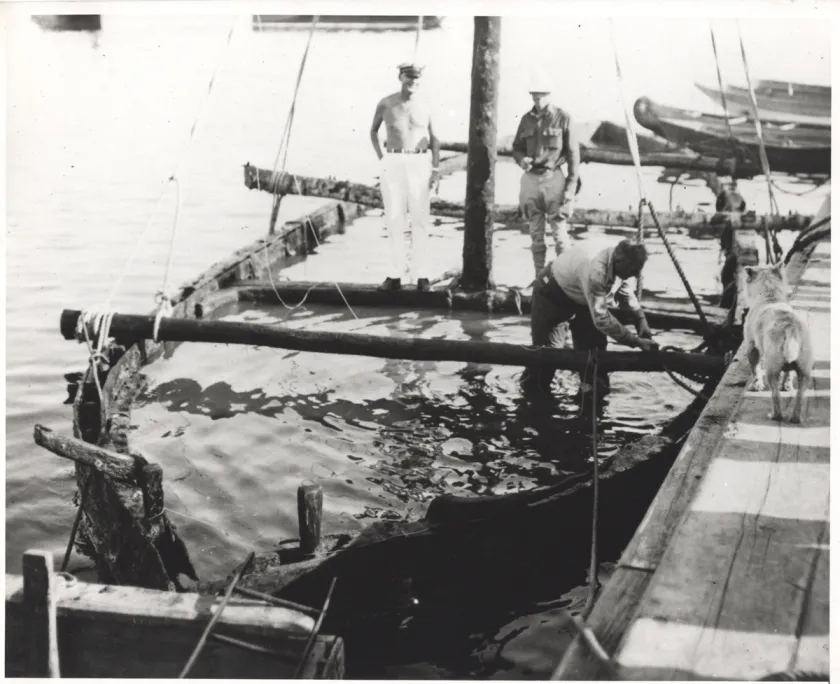
The gunboat Philadelphia being raised from Lake Champlain, 1935.
National Museum of American HistoryWhen Hagglund and his team pulled Philadelphia out of the water, they hadn’t planned much past a salvage operation. Thus, for years after her exhumation, Philadelphia didn’t have a permanent home, spending time in a shed near the shore and then almost a decade as a travelling tourist attraction.
Finally, in 1961, the warship found a permanent home in what is now the Smithsonian Institution’s National Museum of American History in Washington, D.C. But conservators there immediately noticed that after almost 90 years out of the water that had preserved her Philadelphia’s timbers were shrinking, and her iron fittings were disintegrating.
In 2025, the Smithsonian launched “The Gunboat Philadelphia Preservation Project” — a multiyear effort that allows experts to ensure that 250-year-old Philadelphia survives another 250 years. Philadelphia and the nearly 300 artifacts found aboard were placed in a specialized conservation area of the National Museum of American History, where conservation efforts are on display for museum visitors to observe. Conservators are monitoring temperature, humidity and vibrations; removing lacquer and debris; and cleaning the entire gunboat square inch by square inch.
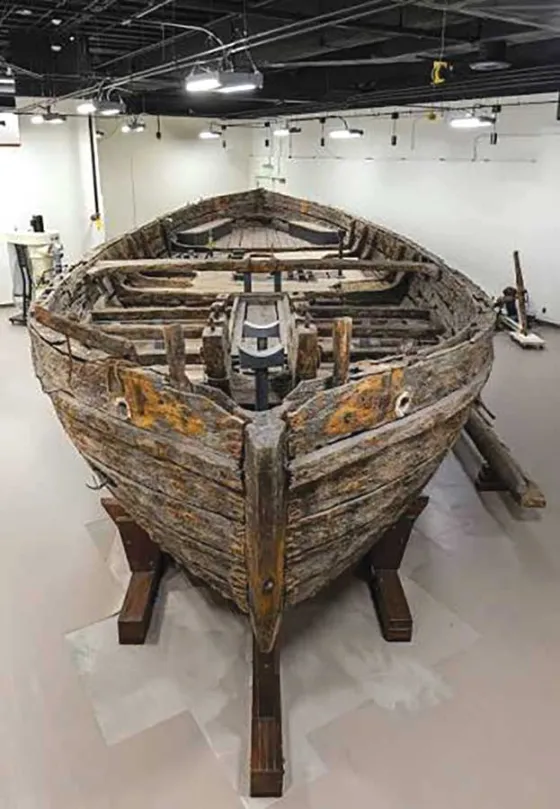
Gunboat Philadelphia
Jaclyn Nash, National Museum of American HistoryThe preservation project is sustained in large part by Americana Corner, an organization founded by American Battlefield Trust trustee Tom Hand and his wife, Char. Americana Corner works to preserve and share the stories of our country’s foundation and guiding principles. Its generous donation to the Smithsonian’s conservation efforts have allowed conservators to work diligently on Philadelphia in line with the United States’ 250th anniversary.
The Battle of Valcour Island is a perhaps under-shared but critical story to the founding of our nation. The acts of the “first American Navy” created a domino effect that allowed Americans to delay British invasion, win critical battles, gain important allies and win the Revolution.
By preserving Philadelphia, the Smithsonian, with help from Americana Corner and multiple other donors, is protecting a massive piece of history — not only in size, but in importance to the founding of the nation and to connecting the American public with stories of the past
Related Battles
200
40