Savannah | Sep 16 - Oct 20, 1779
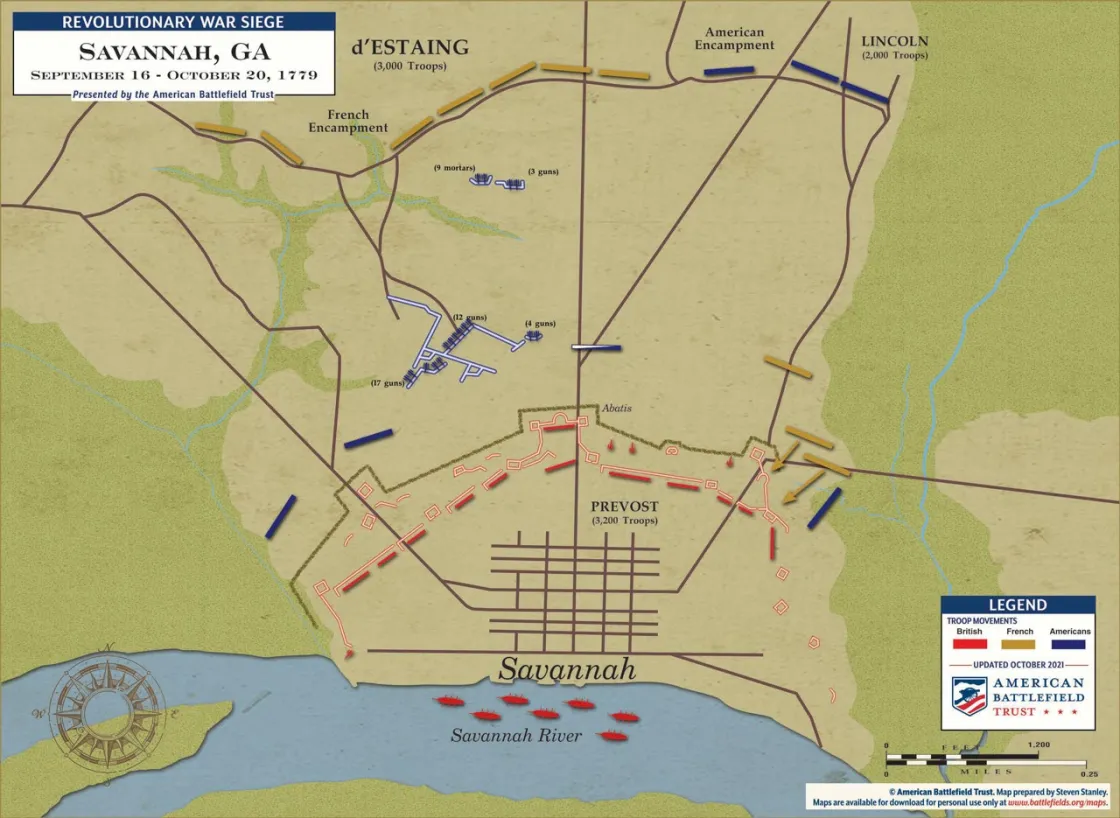
Great Britain relied on the Royal Navy to project their power abroad. To even the playing field, the Americans, too, required a navy. That navy came in the form of the French alliance in 1778. In 1779, the first test in the South of the Franco-American alliance took place as the combined allied forces attempted to retake Savannah.
From September 16 to October 18, 1779, the Franco-American forces worked to dislodge the approximately 3,000-man British garrison led by Gen. Augustine Prevost. The British had constructed an extended entrenched defensive position, which included several redoubts to defend the city. By the end of the siege, the British had more than a hundred pieces of artillery placed along their line.
American forces in the South—between 5,000 and 7,000 men—were based in Charleston, S.C., under the command of Gen. Benjamin Lincoln. Lincoln recognized that he would need assistance from the French navy and army to retake Savannah. On September 3, he learned that the French forces led by Admiral Comte d’Estaing were en route to Savannah, bringing with them ships-of-the-line and a force of soldiers. On September 11, Lincoln marched out of Charleston with 2,000 Continentals to link up with d’Estaing.
Arriving first, d’Estaing began offensive operations to take the city. As was the European custom, he offered Prevost an opportunity to surrender, but Prevost demurred. The American and French commanders held a council of war. Lincoln reluctantly ceded de facto command to d’Estaing. The French commander believed that a frontal assault against the British position would be futile and instead proposed to bombard the city. Lincoln concurred.
French cannons were removed from their ships, and a five-day cannonade began. While the city itself bore the brunt of the artillery assault, the defensive positions remained relatively untouched, so d’Estaing eventually agreed to a frontal assault in spite of objections by his officers. He worried that a protracted siege would take too long—the hurricane season was moving in and a British fleet was still lurking somewhere off the coast nearby.
On the morning of October 9, the Franco-American assault began. Fog shrouded the battlefield and impeded forward progress as troops got lost in the swamps in front of the redoubt they were attacking. This redoubt, the Spring Hill Redoubt, had been selected by d’Estaing because he erroneously believed it to be only lightly defended by local Loyalist militia. In reality, that militia was backed up by battle-hardened British Regulars.
Once the fog lifted, the French lines were fully exposed and crumbled in the face of a withering and incessant fire from the defenders. Admiral d’Estaing himself received two wounds as he personally led the attack. Mortally wounded in the first assault was the Polish cavalry officer, Casimir Pulaski, who had done much to shape the American cavalry forces of the Continental Army. After an hour, the attack was called off.
A week later, d’Estaing sailed away, leaving Lincoln behind and the Franco-American alliance strained. Lincoln’s forces lifted their siege on October 19. Savannah remained in British hands until the end of the war, although Lincoln soon found himself in another siege.
Related Battles
948
155