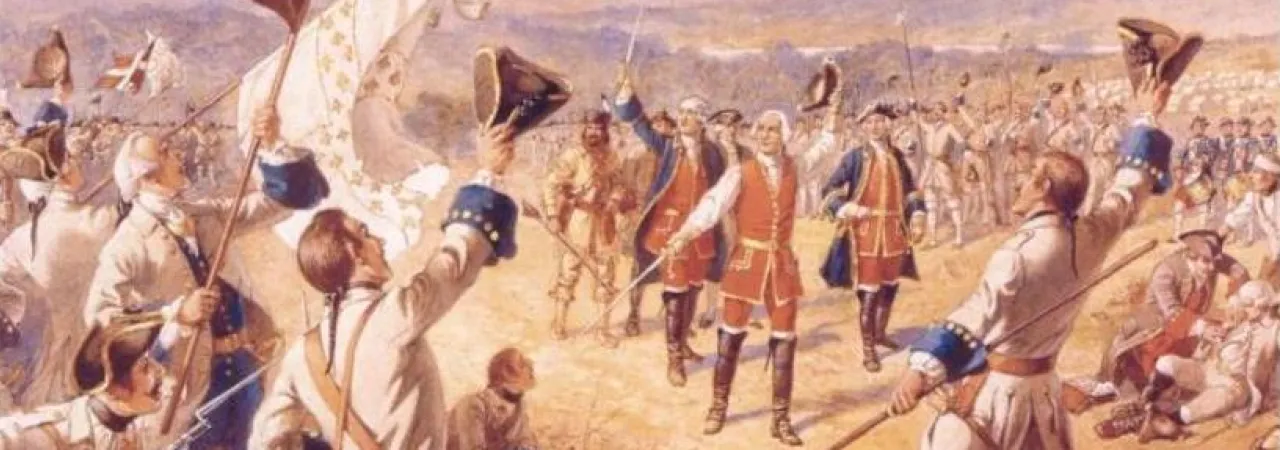
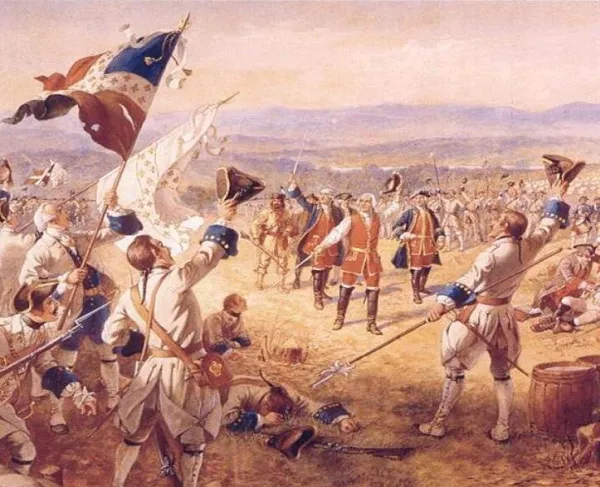
Carillon
Ticonderoga, NY | Jul 8, 1758
After several years of embarrassing and decisive setbacks, the British crown entered 1758 with an aggressive, multi-faceted plan against New France. By year’s end, the British controlled the key French fortresses at Louisbourg and Fort Duquesne. However, the summer’s enormous effort to take Fort Carillon resulted in a setback characterized as “a classic example of tactical military incompetence.” According to one historian, the British effort to capture the Lake Champlain stronghold possessed more errors of judgment that any military campaign “ever launched on American soil.”
Strategically placed between Lake Champlain and Lake George, Fort Carillon was located on the La Chute River, a rapids-filled waterway connecting the two lakes. Begun in 1755 following the French defeat in the Battle of Lake George, the immense fort blocked the British advance up the Hudson River Valley. The fort’s seven-foot-high and fourteen- foot-thick earthen walls were surrounded by a glacis (incline) and a dry moat five feet deep and fifteen feet wide. Abatis (downed trees) strengthened a daunting defensive structure that included thirty-six cannon. Despite its formidable character, Fort Carillon did have flaws—the most serious being nearby high ground where an enemy might place cannon.
The loss of Fort William Henry in August 1757 alarmed the British, who focused on capturing Carillon. By mid-1758, the area around the ruined stronghold at the southern end of Lake George bristled with more than 16,000 soldiers, forty pieces of artillery and ample ammunition.
After reaching the outskirts of Fort Carillon in a 1,000-boat flotilla, the British delayed two days giving the French extra time to sharpen their defenses. After a hasty inspection of the French defenses by an inexperienced junior officer, Abercromby—who did not survey the French defenses himself—ordered an infantry assault. He did not order his artillery forward. Shortly after noon, several thousand disciplined Redcoats advanced toward the French breastworks. According to one observer, the Redcoats were “Cut . . . Down Like Grass.” As the assault stalled, Redcoats sought shelter from French bullets. One survivor who hid behind a stump remembered, “A man could not stand erect without being hit, any more than he could stand out in a shower, without having drops of rain fall upon him.”
With the coming of nightfall and after his army had suffered more than two thousand casualties, Abercromby ordered a retreat, which turned into a stampede when the Redcoats heard rumors of an imminent French counterattack. The largest English army ever assembled on the North American continent to date had been routed by a French force one quarter its size—and not in pursuit.
Carillon: Featured Resources

Related Battles

18,000
3,526
2,600
750