Tyonajanegan
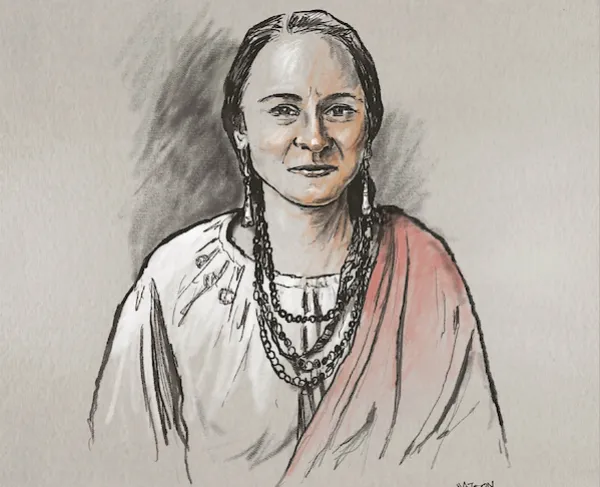
Tyonajanegan, or Two Kettles Together, as she is known in English, was born circa 1740, likely in the Mohawk Valley in present-day New York state. Her exact birthplace and birthdate are unknown. She married Han Yerry Tewahangaraghkan (meaning “He Who Takes Up the Snow Shoe” in English) during the 1750s. As members of the Oneida Nation, they lived in Oriska, an Oneida town near Fort Schuyler. Together, they had at least three children: Cornelius, Jacob, and Dolly.
Before the Revolutionary War, Tyonajanegan and her husband worked to maintain a prosperous farm, where they lived in a frame house and tended to their livestock. This made them among the most prosperous members of their tribe. Han Yerry was also a chief warrior in the Wolf Clan, thus giving the family respect and status.
The Oneida were part of the Haudenosaunee (Iroquois) Confederacy. The Haudenosaunee Confederacy comprised of six Indigenous nations: Mohawk, Oneida, Onondaga, Cayuga, Seneca, and Tuscarora. Although the exact date the Confederacy founded is unknown, it was likely between 1570 – 1600, making it one of the oldest and longest lasting participatory democracies in the world.
Although the nations of the Haudenosaunee Confederacy had largely stayed neutral during the French and Indian War, the Revolutionary War caused major tension that split the Confederacy into those that sided with the British and those that sided with the Patriots. The Mohawk, Onondaga, Cayuga, and Seneca allied with the British, while the Oneida and Tuscarora allied with the Patriots. A major cause for the Oneida siding with the Patriots was their relationship with a man named Reverend Samuel Kirkland. Kirkland served as a Presbyterian missionary to the Oneida from 1764 to his death in 1808. Besides teaching about Christianity, he acted as a translator and mediator for the Oneida people as more colonists tried to settle their land. Being from Boston, as well as having ties to the Congregational and Presbyterian Congregations, Kirkland allied with the Patriots, leading the Oneida to ally with them, as well.
The Siege of Fort Schuyler, August 3 – 6, 1777, urged Tyonajanegan and her family into the Revolutionary War. Fort Schuyler, originally controlled by the British during the French and Indian War, was taken over and rebuilt by Patriots in 1776. It was positioned to protect the Oneida Carry, a portage path situated between the Mohawk River and Wood Creek. For the British and the Patriots, controlling Fort Schuyler meant controlling trade, because the various rivers and lakes that the Oneida Cary sits on connect the Atlantic Ocean to the Great Lakes.
As the British and their Native allies surrounded Fort Schuyler, Tyonajanegan travelled across the countryside to warn settlements of the oncoming siege. On August 5, Patriot General Nicholas Herkimer and 800 soldiers camped by Oriska, preparing to relieve the Patriot troops trapped at Fort Schuyler. Sixty members of the Oneida, including Tyonajanegan, her husband Han Yerry, and their son, Cornelius, joined Herkimer’s force.
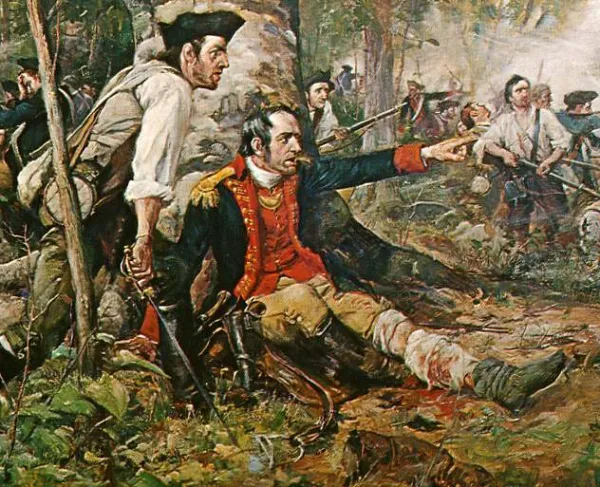
On August 6, Herkimer’s forces were ambushed by British General John Johnson forces and members of the Mohawk tribe. During the battle, Tyonajanegan fired two pistols she had brought from home. After her husband was shot in the wrist, she took it upon herself to reload his musket. She was known for being an exceptional rider, so after the battle, she rode a horse across the Mohawk Valley to warn people of the number of wounded men who would need caring for. Although the Battle of Oriskany was ultimately a British victory and the combined Patriot and Oneida forces sustained heavy casualties, it forced the British forces and their Mohawk allies to fall back to their position at Fort Schuyler. Other Haudenosaunee allied with the British burned Oriska to the ground in retribution for the Oneida siding with the Patriots at the battle.
The Battle of Oriskany was not the last time Tyonajanegan would serve with the Patriot army. She accompanied Han Yerry when he joined Patriot forces during the fighting at Saratoga. Although she is not documented to have fired weapons during these battles, she tended to the wounded and carried messages. Although she did not receive a pension like her husband, who was made a captain in the Continental Army, General Horatio Gates gifted Tyonajanegan three gallons of rum as commemoration for her service.
With no home to return to at Oriska, Tyonajanegan defended her homestead at Fort Timmerman on August 14, 1781 from 150 Loyalist and pro-British Native Americans. Just as little was known about her early life, the later life of Tyonajanegan was not recorded in written history. She died circa 1824.


Related Battles
465
28