Caesar Glover
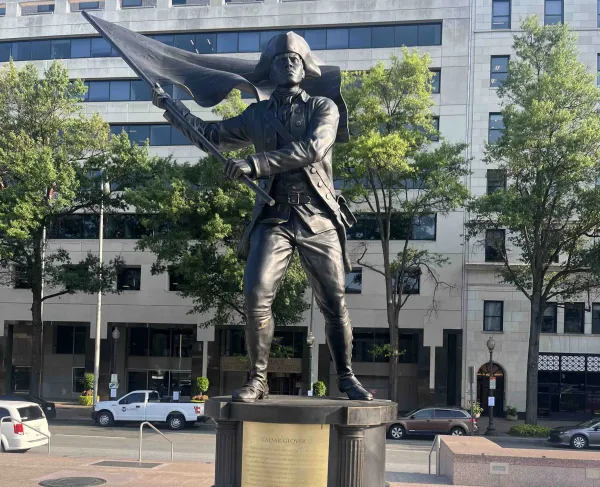
Caesar was kidnapped and sold into slavery from Africa when he was just eight years old. Historians have yet to uncover additional details about where he was born or the first years of his childhood. After arriving in America, he was first sold to Capt. John Miles, a shipmaster in Marblehead, Massachusetts. When Miles died, his widow sold him to Jonathan Glover, whose brother was the Revolutionary War officer John Glover. Amid rising tensions with the British, John Glover formed the Marblehead Regiment, which Caesar joined in 1775 when he was around 33 years old.
Because Marblehead was a port city and fishing community, many of the men who served in Glover’s regiment with Caesar could fight on land or water. The regiment was also highly integrated, with white, African American, and Native American soldiers serving side by side. The Marblehead Regiment played a crucial role in important Revolutionary War engagements, like the Siege of Boston, the Battle of Bunker Hill, and the New York and New Jersey Campaigns. Their experiences at sea proved valuable, like when they evacuated the Continental Army from Long Island in 1776 and when they guided General George Washington’s boats across the Delaware River on Christmas night of 1776.
Sometime in 1777, Caesar joined the 16th Massachusetts Regiment, which was a state militia unit. They fought with Washington’s army for much of the Philadelphia Campaign and fought at the battles of Monmouth and Rhode Island. By the end of 1778, Caesar returned to civilian life and settled in Boston as a free man.
Caesar’s motivation to enlist and the circumstances of his freedom in 1778 are not documented. During the Revolutionary War some enslavers manumitted enslaved men who enlisted and served. Massachusetts accounted for almost 40% of African American Patriot enlistments in the war and the state banned slavery in 1780.
After his service, Caesar settled in a racially diverse community on the north slope of Boston’s Beacon Hill. He worked as a laborer on the Long Wharf and in 1801, at 59 years old married Susannah Parsons. By 1817, his wife had died of illness and he and his daughter Sukey were on the “Town Poor” rolls. After a new federal relief law was passed for Revolutionary War veterans in need, he applied for a pension in 1818. The government approved his application for assistance, and he received a pension until his death in 1822. He is buried in South Burying Ground in Boston and was one of the few African-American residents to receive an obituary in the Columbia Sentinel.