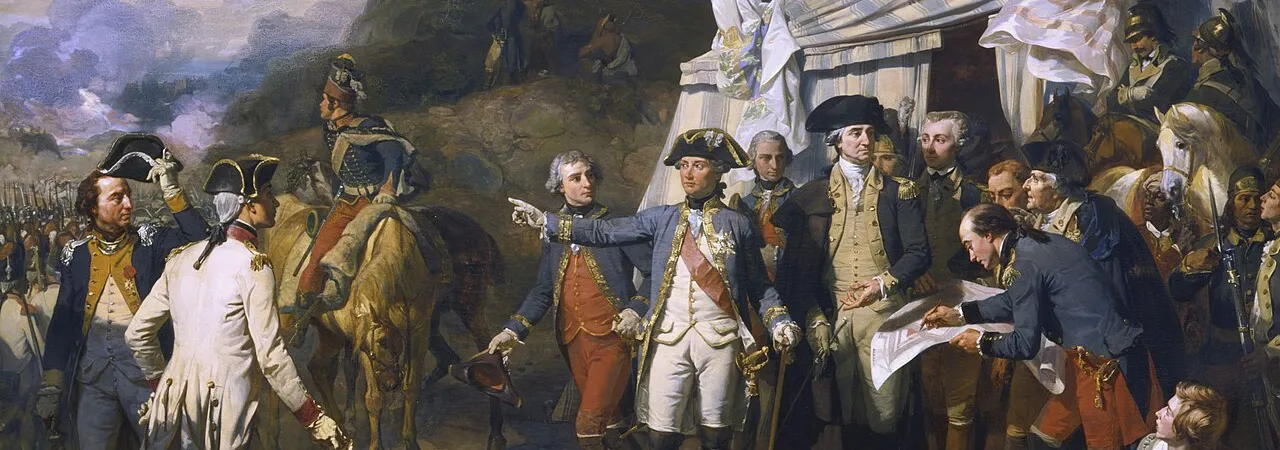
Siege of Yorktown (1781), 1836. Painting by Auguste Couder. Palace of Versailles, Galerie des Batailles.
For the young Johann Conrad Dohla, a private soldier and German auxiliary in the Bayreuth Regiment, October 19, 1781 marked an end to several weeks of misery. He and almost 8,000 other British, German, and American Loyalist troops under General Charles Cornwallis had withstood more than half a month of bombardment and attack from an army of over 18,000 French and American troops surrounding them at the small tobacco hub of Yorktown on the York River. In a diary kept throughout the war, Dohla wrote of seeing his enemies face to face as they marched to surrender their arms in a meadow now known as Surrender Field:
“We, now captives, looked with wonder and astonishment at all these troops, which formed a line three men deep and tending for more than an English mile, because such a force had besieged us and could have eaten us up, and by comparison we appeared to be no more than a guard mount.”
Other soldiers found it difficult to contain their frustrations, as mentioned by Captain Samuel Graham of the 76th Highlanders in his memoirs written after the war: “A corporal next to me shed tears, and, embracing his firelock, threw it down, saying, ‘May you never get so good a master.’" The surrender ceremony in which these defeated men laid down their arms in piles marked the beginning of almost two years in captivity, and for some, the end of their enlistment with the British Army.
The army that surrendered to General George Washington and the Comte de Rochambeau was mentally and physically exhausted from a year of campaigning. In addition to the constant shelling of their defensive works during the Siege, much of Cornwallis’s army had suffered from smallpox and malaria, which had plagued his army throughout the summer of 1781. There were also varying degrees of fatigue from the previous campaigns that year. Men such as those in Hessian Regiment Von Bose and the Scottish 71st Regiment, Fraser’s Highlanders had been engaged in the war since 1776 and served as experienced veteran regiments in Cornwallis’s army, having recently fought throughout the Southern Campaigns in the Carolinas. Other newer units such as the 80th Regiment, Royal Edinburgh Volunteers and 76th Regiment, MacDonald’s Highlanders had seen only limited combat in skirmishes around New York but had served with distinction in the 1781 Virginia Campaign under Brigadier General Benedict Arnold and Major General William Phillips. Attached to this force were eighty followers of the army, including women and children, a constant in both armies of the American War for Independence. Women followers had the vital role of washing, nursing, mending clothing, and various contracted work for the army. As a result, they were regulated and rationed by the Army and would face the same privations and difficulties as the soldiers on campaign. Both green and veteran troops, along with the families following the army would now find themselves in the same situation as their predecessors in General Burgoyne’s “Army of the Convention” captured after the Battle of Saratoga in October 1777 and marched to prisoner of war camps in Virginia.
After laying their arms, the prisoners departed Yorktown on October 21 marching north under terms of capitulation signed by both sides. Under these terms, the troops were to be kept within the confines of Virginia, Maryland, and Pennsylvania and were to keep their possessions and belongings as they journeyed to their destined prisoner of war camps. Leaving behind roughly 2,000 wounded and sick soldiers to be cared for by British surgeons, the prisoners departed under guard of Virginia militia companies. On their way north, they passed through Williamsburg, traveling toward Fredericksburg where they arrived on October 30. They crossed the chilled waters of the Rappahannock River at waist-high depth and arrived in Falmouth on November 1. Just north of town the prisoners split in two groups. Some 3,000 troops marched toward the city of Winchester, while roughly 2,900 others continued north toward Fort Frederick in Washington County, Maryland.
As the Winchester bound prisoners continued through the Virginia piedmont, many began to notice the geographic and cultural differences from the tidewater they had become accustomed to in the previous year. Private Dohla remarked at his first witnessing of the Blue Ridge Mountains while traveling along the road that would become today’s Route US-17 in Fauquier County, Virginia on November 3: “We made a long march. As evening we noticed the so-called Blue Mountains, of an astonishingly great height and covered with heavy forests. Here, in the middle of a forest and undergrowth, we made our night quarters”. At the head of the column, Captain Graham of the 76th described the lawlessness of the march:
“Our guards were all from the upper parts of the state, called backwoodsmen, between whom and the inhabitants of the lower parts there existed no cordiality; and at night when we halted, they not only allowed, but even encouraged our men to pull down and make fires of the fence-rails, as we had been accustomed to do when we had arms in our hands; and when a proprietor complained they only laughed at him. They did not scruple also to let us make free with a turnip field.”
Because prisoners were provided with little food (often flour, salted beef, and pork), the local communities along their route frequently fed prisoners, sometimes involuntarily. As the troops crossed over Ashby Gap, and into then Frederick County (now Clarke), they again waded in freezing cold temperatures across Shenandoah River to Winchester. Upon arriving at their camp a few miles outside the town, the POWs found a dire situation regarding the state of their quarters. Captain Graham, being the senior officer, found that the small wooden huts built for the soldiers were unfinished and without roofing. With snow and freezing rain expected as winter weather rapidly approached, he quickly petitioned the commissary of prisoners for redress, which was largely ignored for the time being. In the meantime, the prisoners attempted to make these conditions more suitable for a temporary home, and quickly set about building up their huts, as described by Dohla: “We closed the roofs and filled all the holes in the walls with wood and clay to protect ourselves from the cold…We also collected bullrushes in the forest and cut grass, which served as mattress filler.”
The prisoners in Western Maryland’s Fort Frederick did not fare better than those at Winchester, with hundreds of men cramped into tight conditions of a fort with a capacity far below its designated 2900 prisoners. Commissary General of Prisoners Abraham Skinner seeing the conditions of the fort, wrote to Washington on November 23, having moved the prisoners from the fort to the town of Frederick, Maryland:
“Upon examination I found that the situation of the barracks at Fort Frederick was insufficient for the reception of the prisoners—indeed they are almost totally destroyed and cannot be repaired unless at a great expence, neither can provisions be furnished for it so conveniently as at Frederick Town where I have got them into Convenient Barracks around which a Stockade is erecting that will effectually secure them and lessen the duty of the Guard. We have also provisions at that Post of Beef & Flour for about Six Weeks.”
Earlier in the war the town of Frederick had been chosen as a site to house Maryland’s soldiers in a set of permanent barracks, but after its construction found more use housing prisoners of war, including Burgoyne’s Convention Army. The barracks, along with a jail in the town would be the home for these troops until being shifted yet again to a new destination.
As they endured captivity, prisoners in both Winchester and Frederick found work amongst the community to help offset the meager rations they received in captivity. The Marquis de Chastellux, a French officer serving under General Rochambeau witnessed a more positive side of the conditions of prisoners, as he recorded his travels through Winchester in 1782:
“Stopping one day at a smith’s shop near Winchester, in the interior of Virginia, I found one of the workmen to be a Scotch Highlander in his Gaelic dress, and soon saw several more returning from harvest; these men had been soldiers, and were then prisoners, but they were all peaceable industrious labourers, and I could not find that any of them thought of returning to the barren hills of Caledonia. General Gates had several of them in his employ, and they were dispersed over the whole country, where they appeared completely naturalized and happy.”
The truth is likely not entirely as Marquis’ would claim of prisoners not resigned to their work, but rather entirely assimilated into the community, though it was at this time that many would desert for new lives in Virginia, Maryland and Pennsylvania. Some, like George Abel of the Erbprinz Regiment would desert, marry, have children, and live out the rest of their lives in German speaking communities of the “German Settlement” of northern Loudoun County, Virginia. Others found opportunities for their future in German speaking Frederick, mere steps away from the barracks and jail that once contained them. For the rest of the prisoners, Frederick would simply be another temporary home among several before the end of the war.
At the end of December 1781, it was determined that all prisoners in Frederick and Winchester would be moved to Lancaster, Pennsylvania, where they would be met by the prisoners of the Convention Army. Beginning in January 1782, prisoners marched in batches toward Lancaster, and upon arrival found the site of two distinct camps, as described by Captain Graham: “At Lancaster the soldiers were kept in a tolerable barrack, surrounded by a high stockade, and strictly guarded. At York they were kept in huts newly constructed, also surrounded by a high stockade, and were also strictly guarded. At a little distance from, but in sight of, our men's huts, upon a rising ground were situated a number of huts occupied by soldiers of General Burgoyne's army, also prisoners of war, but without stockade or guard. Our men named their own camp ‘Security,’ and the other camp ‘Indulgence.’" The prisoners remained here throughout 1782, as peace negotiations began between Britain and the United States in Paris. Between late 1782 and Spring 1783, the POWs were marched in divisions back to British lines in New York, departing for their home countries later that year.
Further Reading:
- A Hessian Diary of the American Revolution by Johann Conrad Dohla, Translated, edited, and with an introduction by Bruce E. Burgoyne
- Captives of Liberty: Prisoners of War and the Politics of Vengeance in the American Revolution by T. Cole Jones
- A Generous and Merciful Enemy: Life for German Prisoners of War during the American Revolution by Daniel Krebs
Related Battles
389
8,589