Lt. Gen. Richard P. Mills (USMC, Ret.)
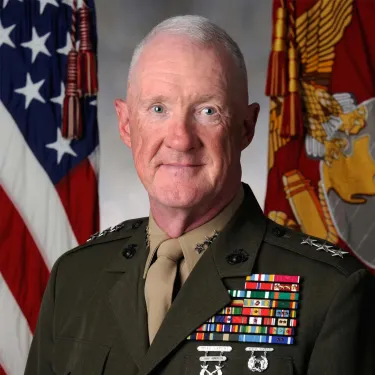
Lieutenant General Richard P. Mills, 2013.
United States Marine CorpsRetired Marine Corps Lt. Gen. Richard P. Mills has been a strong advocate for battlefield preservation and the use of historic landscapes in military education. Having commanded Marines in combat zones in Kosovo, Iraq and Afghanistan, Mills understands the importance of preserving battlefields as memorials to those who served and as places where future generations can learn from the past.
A native of New York, Mills received his commission as a second lieutenant in 1975. Over the course of his military career, he held numerous command and staff positions, including service as a United Nations military observer in Palestine, on the staff of the commander of the United States Sixth Fleet and as assistant chief of staff at United States European Command in Stuttgart, Germany. His professional military education included studies at the Marine Corps Command and Staff College and the United Kingdom's Royal College of Defence Studies.
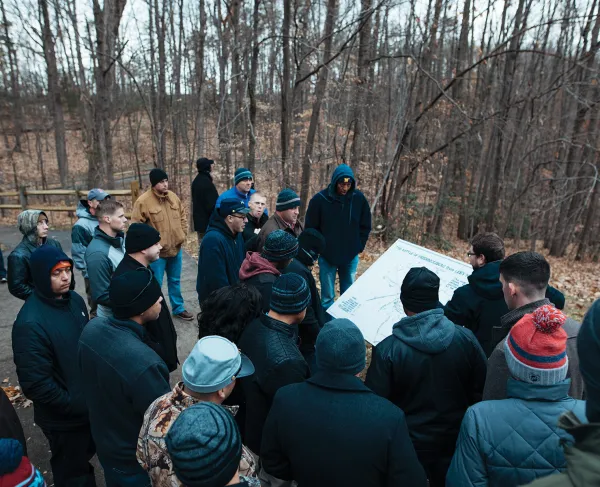
Following his retirement from the Marine Corps, Mills became president and CEO of the Marine Corps University Foundation, a nonprofit organization supporting the professional education of Marines. The foundation has helped provide educational resources, advanced library technology and academic opportunities while supporting the Marine Corps' longstanding tradition of battlefield staff rides.
Mills' advocacy for staff rides first brought him into contact with the American Battlefield Trust during efforts to protect Princeton Battlefield in New Jersey. Recognizing the importance of the Trust's mission, he became increasingly involved in its preservation work and joined its Board of Trustees in early 2017.
“So many veterans like myself look over our shoulders for inspiration from past triumphs on past battlefields,” Mills told Stars and Stripes during the Princeton preservation controversy. “More importantly, it is crucial that we take our young people to these battlefields. Only then can they really get a feel for our history. The battlefield, as an outdoor classroom, reveals its subtle dips and depressions, places that provided mere inches of life-saving cover during an enemy volley. Only on a preserved battlefield itself can you walk the walk. That’s why it’s so important to save hallowed ground.”
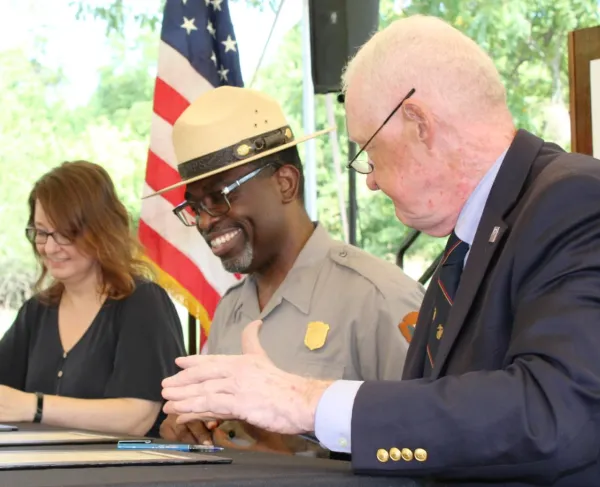
Through Mills' involvement, the Trust and Marine Corps University developed a partnership supporting the use of preserved battlefield properties for military staff rides. He also advocated publicly for battlefield preservation and military education through articles in the Richmond Times-Dispatch and The Free Lance–Star.
“In this age of tanks, helicopters, jets, rockets and drones, how can we learn from a battle fought on horseback or on foot? When you take it down to the basic principles, war hasn’t changed,” Mills wrote. “The training touches a deeper chord, too. We use history to build the values and traditions of military service and reinforce its discipline and standards. The history ... helps us instill unit cohesion and unit pride. You stand up to the challenge because the soldiers on both sides of you stood up.”
Through his military leadership, educational work and preservation advocacy, Mills has helped demonstrate the continuing value of America's historic battlefields as places of remembrance, reflection and learning.