For the First Time in a Century, Major Preservation Effort Underway at Chalmette, War of 1812’s Last Battle
Jared Herr, jherr@battlefields.org
(NEW ORLEANS, La.) — A major tract on the Chalmette Battlefield, where General Andrew Jackson, known to history as “Old Hickory,” fought to victory in the final, climactic battle of the War of 1812, may soon be saved forever. If the American Battlefield Trust is successful in its $1 million fundraising campaign, the 40-acre tract, hemmed in by industrial development, will be the battlefield park’s first major expansion in a century.
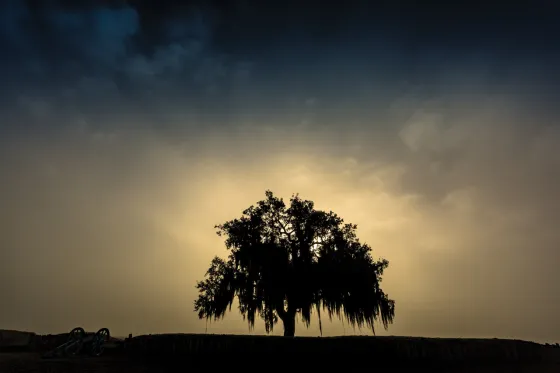
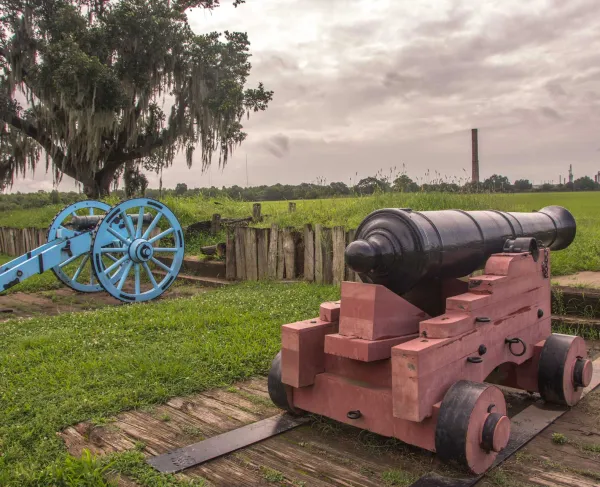
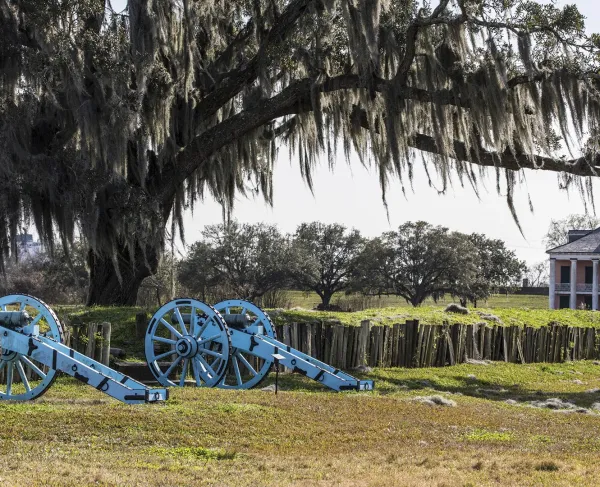
Chalmette Battlefield, La.
Zack Smith“Just days ago, we celebrated the 250th anniversary of the Declaration of Independence, the powerful document that propelled the American Revolution; now, we are delighted by this tremendous and rare opportunity to preserve a portion of the Battle of New Orleans, an engagement often hailed as the grand finale to America’s ‘Second War of Independence,’” said David Duncan, president of the American Battlefield Trust.
Portions of the iconic battlefield are preserved within Jean Lafitte National Historic Park and Chalmette National Cemetery, but other sections, and much of the surrounding area, have been lost to industrial development. But somehow, these 40 acres across which the several British regiments charged — and subsequently retreated — remain open and unimproved
“This acquisition preserves the largest remaining unprotected acreage associated with this pivotal event,” said Louisiana Lt. Gov. Bill Nungesser. “Protecting it from development will enhance the Jean Laffitte National Historical Park and the Chalmette National Cemetery. It will also serve as an educational resource and support increased heritage tourism in St. Bernard Parish and across Louisiana.”
The battle stands as a tribute to the American ability to overcome differences in pursuit of a common goal. Badly outnumbered, the Americans inflicted more than 2,000 casualties, while suffering only 71 themselves. Its unconventional story was popularized in 1959, when Johnny Horton’s “The Battle of New Orleans” became a massive Billboard #1 hit, winning the Grammy Award for Best Country & Western Performance.
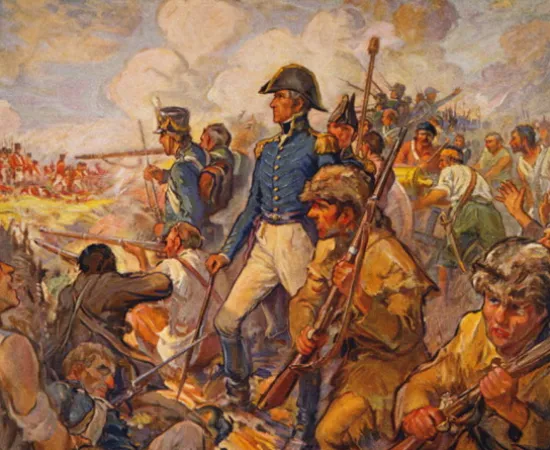
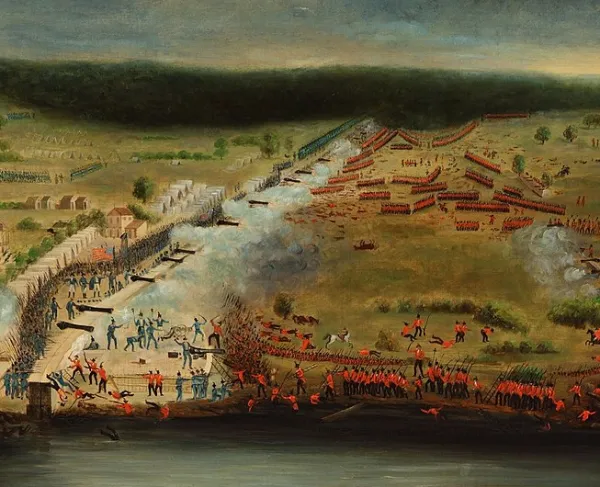
Andrew Jackson During the Battle of New Orleans, 1922, by F. C. Yohn.
Library of CongressBecause of zoning considerations and intense development pressure, the transaction cost is $3.6 million. But thanks to anticipated matching funds from the federal American Battlefield Protection Program and the Trust’s first-ever award from the Louisiana Outdoors Forever Program, plus early gifts from major donors, the Trust needs to raise just $1,006,582 by September 2.
The project has also received significant local support.
“Few places tell the story of America’s past as powerfully as the Battle of New Orleans, and St. Bernard Parish is honored that the American Battlefield Trust has chosen to preserve this historic property,” said parish historian William de Marigny Hyland. “This acquisition complements the National Park Service’s outstanding stewardship of the Chalmette Battlefield by enhancing opportunities for interpretation, education, and exploration while preserving an invaluable piece of our nation’s military history for future generations.”
The War of 1812 was winding down when British troops landed just south of New Orleans in December 1814. Their goal was to capture the city, and with it, control of the Mississippi River, the vital waterway on which America’s prosperity and future growth depended. On the other side of the Atlantic, diplomats signed the Treaty of Ghent on December 24, but word had not reached the sugarcane field at Chalmette where Jackson’s hastily assembled force gathered on January 8, 1815. A combination of U.S. Army regulars, Choctaw Indians, pirates and volunteers of every race, language, religion and social class from across Louisiana and the southeastern United States defeated the mighty British military, cementing Jackson’s hero status and setting him on a path to the White House.
The American Battlefield Trust is dedicated to preserving America’s hallowed battlegrounds and educating the public about what happened there and why it matters today. The nonprofit, nonpartisan organization has protected more than 62,000 acres associated with the Revolutionary War, War of 1812 and Civil War across 160 sites in 25 states. Learn more at battlefields.org.