10 Facts: 1812 Battle of New Orleans
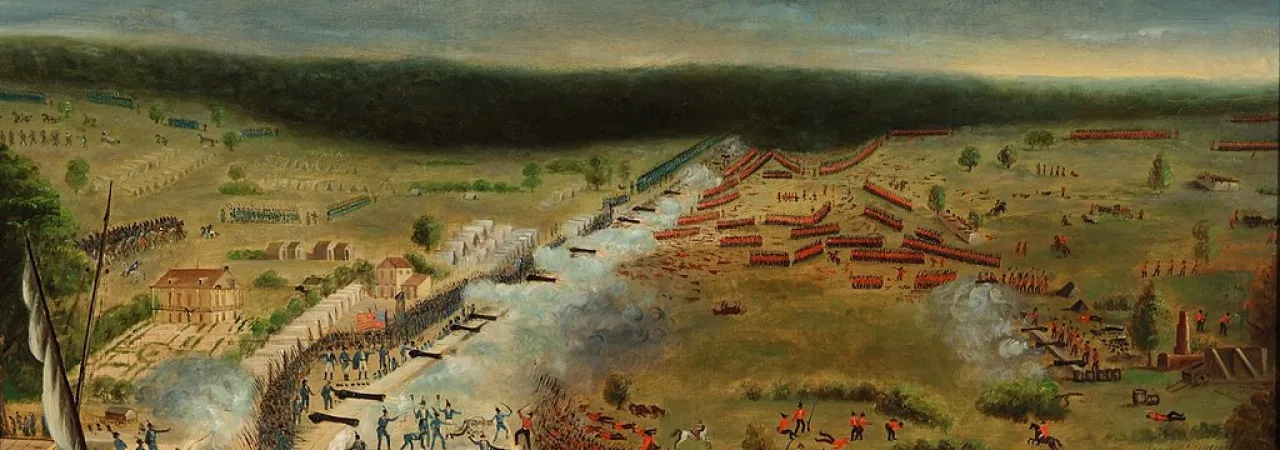
"The Battle of New Orleans" as painted by Jean Hyacinthe de Laclotte.
Fact #1: New Orleans was a lucrative prize, economically and strategically.
Louisiana became a state less than two months before the War of 1812 began. Nevertheless, the territory, purchased as part of the Louisiana Purchase in 1803, was crucial to the transportation of goods, particularly produce, in the United States. At the beginning of the War of 1812, roughly one-third of U.S. produce passed through the ports in New Orleans. Additionally, New Orleans received its first steamboat in 1812, which enabled easier transportation of goods up the Mississippi River. Control of the city ensured control of the Mississippi River and access to the interior of the growing United States.
Fact #2: The British initially planned to attack the city via an overland route.
British forces established a base in Pensacola, Florida in August 1814, and planned to march to New Orleans from Pensacola before moving on to capture Mobile, Alabama. U.S. forces under Maj. Gen. Andrew Jackson successfully defended the attack on Mobile in September 1814. Jackson then invaded Spanish-held Florida and briefly captured Pensacola, forcing the British to approach New Orleans from the sea.
Fact #3: The first land battle around New Orleans took place on December 23.
British Vice Adm. Alexander Cochrane’s fleet defeated an American fleet on Lake Borgne before landing below New Orleans. Cochrane and Maj. Gen. John Keane ferried their troops through the bayous south of New Orleans before arriving in the city on the morning of December 23. Jackson, after arriving in the city earlier that month, marched out to engage them. In a rare nighttime battle, the two sides engaged on the De La Ronde Plantation. The fighting was inconclusive, and Jackson withdrew to a new position on the Chalmette Plantation. He placed his men along the Rodriguez Canal and they built a parapet known as "Line Jackson".
Fact #4: The British commander did not arrive until after the fighting began.
Lt. Gen. Sir Edward Pakenham, the brother-in-law of the Duke of Wellington, did not reach his new command until Christmas Day, 1814. Pakenham was frustrated by Cochrane and Keane not defeating Jackson at the De La Ronde Plantation and moved his forces to Jackson’s position at the Chalmette Plantation on December 27.
Fact #5: Both the U.S. and British armies were integrated.
Jackson's force consisted of U.S. Regulars and Marines, Free Men of Color, Baratarian pirates, militia from Tennessee, Kentucky, and Mississippi, citizens of New Orleans, and Choctaw Indians. Two Black regiments from the West Indies served in the British army.
Fact #6: The 7th U.S. Infantry earned their nickname at the battle.
The regiment became known as the "Cottonbalers" after fighting at New Orleans because they used cotton bales to reinforce defensive works on Line Jackson during the battle.
Fact #7: The British sustained heavy casualties during the main attack.
On January 8, Pakenham attacked in the early morning. He expected his troops to be covered by heavy fog, but the fog lifted and gave American troops a clear sightline of their approaching enemy. It did not help that British troops wore bright red coats, which made them even easier to spot. Of the 3,000 men under Maj. Generals Samuel Gibbs and Keane, the British suffered around 2,000 casualties in about 30 minutes, including Pakenham. In total, there were 2,034 British causalities from the battle.
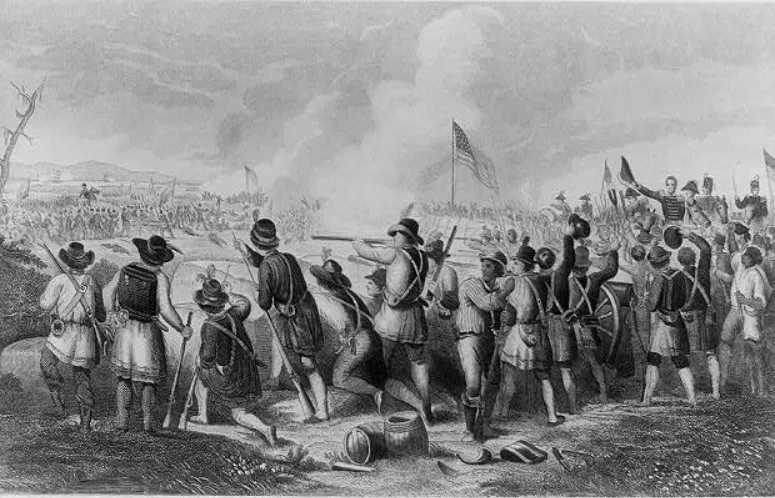
Fact #8: Another British attack nearly succeeded.
A British column under Col. William Thornton managed to break through the U.S. defenses on the right bank of the Mississippi. However, the devastating losses in front of Line Jackson compelled Maj. Gen. John Lambert, who replaced Pakenham, to abandon the effort and recall Thornton and his soldiers.
Fact #9: The battle was a political springboard.
Jackson's victory made him a national hero. The War of 1812 ended a little over a month after the battle when Congress ratified the Treaty of Ghent. Jackson’s fame following the Battle of New Orleans catapulted him to two terms as President, beginning in 1828.
Fact #10: The battle became a national holiday.
Along with Washington's birthday and the Fourth of July, the date of the battle, January 8, became a holiday celebrated and commemorated in the United States. It was called the Glorious Eighth of January and was celebrated with dances, parades and speeches, but Americans became less enamored with it after the Civil War.


Preserve some of the most important acres from the War of 1812 that we will EVER be able to save! This is likely the LAST and certainly the LARGEST...
Related Battles
71
2,034