Remembering the 1812 Battle of New Orleans
When compared to America’s major wars, the War of 1812 is arguably the nation’s “forgotten conflict”. With no decisive result, the war is more often than not little more than a footnote in the larger narrative of the nation’s political, military, and geopolitical history. Scholarly treatments of the war are few and among the public the war’s invisibility is even greater. Perhaps there is nodding recognition that the national anthem, The Star-Spangled Banner, was penned during the September 1814 bombardment of Fort McHenry at Baltimore. Mayber there is a faint recollection that the nation’s capital was captured and burned during the Chesapeake Campaign. Maybe the recollection that American troops invaded Canada comes to mind.
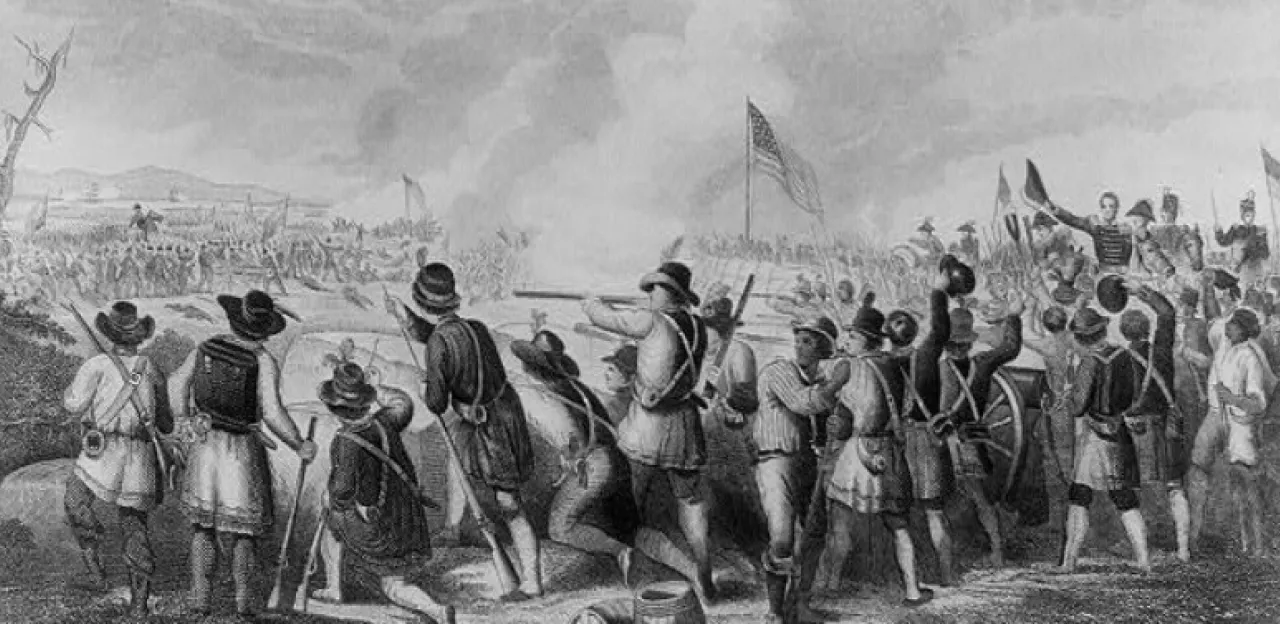
Despite this, however, one incident of the war -- the Battle of New Orleans, fought on January 8, 1815, holds a special place in Americans’ celebratory memory. As a historical event, the battle was dramatic. A small patchwork army – militia, pirates, enslaved Blacks, free Blacks, Creole militiamen, volunteers from Kentucky and Tennessee, and United States Regulars -- inflicted a stinging defeat on some of the most veteran and experienced troops from the British army. In its popular re-telling – or as scholars put it as a form of public memory – the battle’s significance speaks more about an appeal for an evolving set of present-day expressions of patriotism and national pride than to the military and diplomatic significance of one of the nation’s most celebrate military victories.
In its immediate aftermath, the battle carried both practical and symbolic meaning. Because the Treaty of Ghent had not been reported in the United States when the battle raged at Chalmette, the defeat was simply operational – United States forces held New Orleans, but British troops continued to campaign to control the Mississippi estuary and shape regional trade. When news of the treaty arrived, United States military victory meant that British military efforts to control the Gulf coast region were over and that British forces were required to abide by the final peace treaty which returned things to status-quo antebellum. At the same time, in the United States victory, punctuated by the overwhelming success in the war’s final battle affirmed national identity and brought people “together as one nation.” (Kikaberidze, “The Dress of Empire: The War of 1812 in an International Context”)
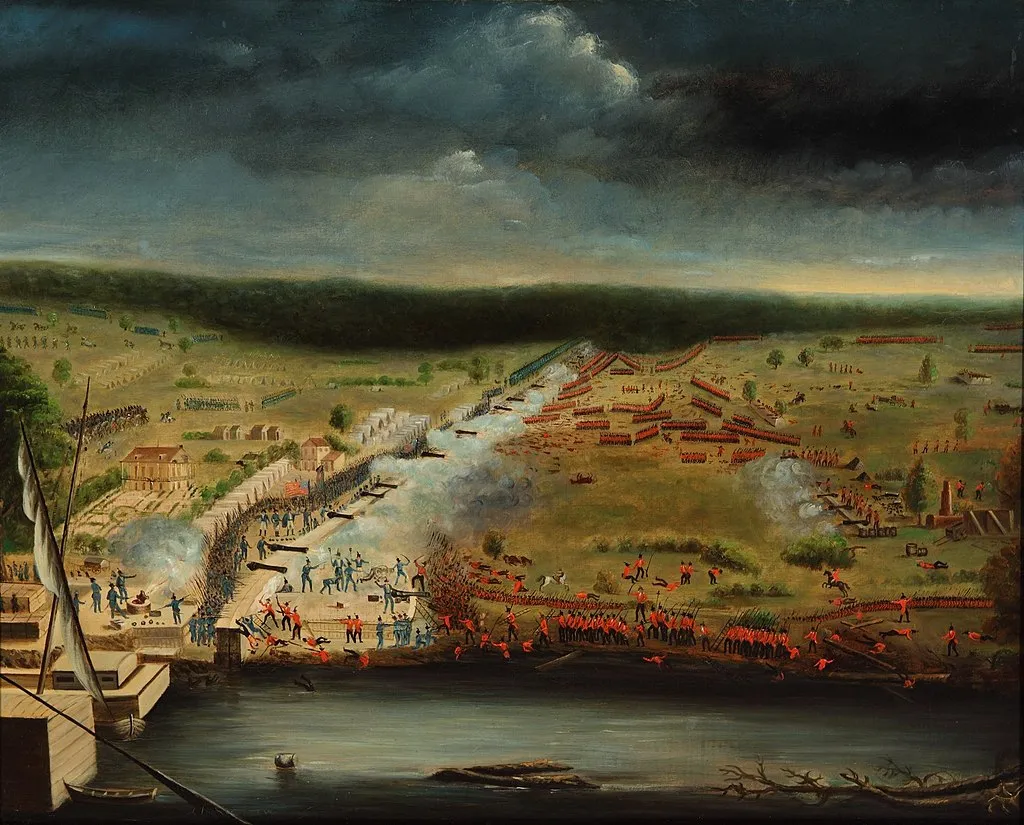
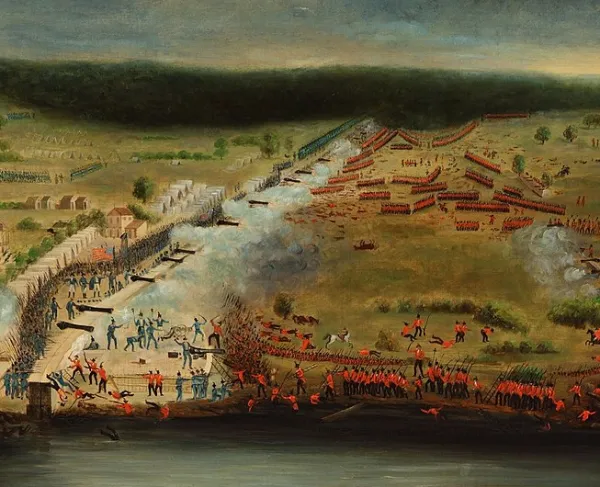
"The Battle of New Orleans" as painted by Jean Hyacinthe de Laclotte.
Public DomainAs time passed, the American public’s fascination with Andrew Jackson’s rough-hewn backwoods personality and his bids for the Presidency became inextricably linked to the battle. For many, Jackson – who in the years after the battle became the subject of iconic artistic renderings -- represented an idealized vision of American manhood whose practical and unpretentious heroism appealed to everyday men and women. He was also seen as the embodiment of the Revolutionary and the early republic’s nationalistic pride whose and anti-British public sentiment. He and his own family’s tragic experience with British violence resonated with Americans who saw royal government and monarchy in general as illegitimate and an ongoing threat to popular self-government. Jackson gave that image reality and his victory over the best of the British army while at the head of cobbled together force of American characters gave power to the image of rough-hewn independence standing against the corruptions of the old world’s politics.
For the veterans who lived on the nation’s margins at the time of the battle, how others remembered the battle brought mixed results. At the time of the battle Creole citizens of New Orleans lived between two worlds – the old Spanish and French influenced one and the new American one. For the United States’ government, the presence of men of French and Spanish descent whose political identity was rooted in colonial royalism rather than republicanism presented a serious threat. But New Orleans’ Creoles embraced “American ideals” and the Battalion d’ Orleans’ service under Jackson confirmed their loyalty to republican ideals and the United States. (“In Defense of Liberty: The Battalion d’Orleans and Its Battle for New Orleans”, in The Battle of New Orleans in History and Memory)
Other veterans of the fight, however, were forgotten in the decades after the battle. In his mobilization of as many men as he could muster, Jackson promised enslaved Louisianians that if they helped fight the British, they would be freed. Free Black men, who volunteered believed that their service would raise their social standing. Reality proved different. Black veterans – both free and enslaved -- were not recognized for their contribution until 1851. Precious little, either in terms of respect or in terms of financial gain ever accrued to the black men who helped man the front line at Chalmette. (Gene Allen Smith, “ ‘Objects of Scorn’: Remembering African Americans in the War of 1812”, in The Battle of New Orleans in History and Memory)
In the years after the battle, American’s celebrated the victory at New Orleans with a nationwide holiday variously called Jackson Day, the “Eighth of January” or Battle of New Orleans Day. Especially in the Southern states that sent troops to the battle, parades, speeches and public gatherings marked the day. It remained a regular part of the nation’s memorialization through the mid-nineteenth century though it began to decline in popularity after Jackson’s divisive presidency and continued to lose its place on the calendar of national celebrations as sectional politics divided the Union. By the 1880s the holiday was hardly noticed.
In the face of the decline, during the late 19th century, women established a variety of patriotic and commemorative organizations -- most famously the Daughters of the American Revolution (1890) and the United Daughters of the Confederacy (1894). On January 8, 1892, Cleveland, Ohio resident Flora Adams Darling organized The National Society United States Daughters of 1812 to promote the memory of the war and especially the Battle of New Orleans and Andrew Jackson. Though a national organization headquartered in Washington, D. C., the Daughters’ membership was heavily concentrated in Louisiana and Tennessee.
They helped promote the idea that the War of 1812 was “a second American Revolution in which the various states of the Union fought as one in a common cause.” And like other women’s patriotic organizations – most notably the Ladies Hermitage Association (1889) that preserved President Andrew Jackson’s Tennessee home and the Mount Vernon Ladie’s Association (1853) that saved and maintained the Virigina home of President George Washington, the Daughters of 1812 pursued a preservation agenda. Successful in protecting a portion of the battlefield and in erecting a monument to Jackson’s army, the Daughters proved unable to continue to fund the upkeep of the monument and surrounding grounds. They transferred title to the War Department which had barely a decade before been charged with preserving and maintaining a group of five Civil War battlefields. Despite their inability to manage the battle site, the Daughters promoted educational efforts and whole heartedly embraced and promoted the idea that the battle had been fought and won by frontier militia armed with hunting rifles.
The celebration of the battle’s centennial drew more attention to the war than had been paid in many decades. But very different stories came out of the celebration. For the Ladies Hermitage Association and the Nashville Daughters of 1812, the battle was simply a celebration of Jackson and his frontiersmen. Among other, chiefly the Daughters in New Orleans, the anti-British sentiment was downplayed in an effort help solidify relations with Great Britain. Unsurprisingly, both the black veterans and the old creoles who fought in the battle were barely remembered at all.
Musical and poetic tellings of the story of the Battle of New Orleans, songs, plays, and poems about the fight began to come to market soon after the fight ended; including Philip Laroque’s “Battle of the Memorable 8th of January” 1818; C. E. Grice’s 1816 The Battle of New Orleans; an Historical and National Drama, in five acts; Richard Emmons’ 1827 poem titled General Jackson’s Victory at New Orleans; and a Civil War-era song sheet titled Old Hickory’s Days. Of all the 19th century compositions, “The Hunters of Kentucky” based on Samuel Wordsworth’s poem proved to be among the most popular songs of the mid-19th century. By celebrating the role of Kentucky sharpshooters armed with long-rifles, the song captured the mood of the populist politics of the 1820s and 1830s in its celebration of the common man.
For 20th and 21st century audiences, the most famous of all versions of the battle is Johnny Horton’s 1959 chart topping, “The Battle of New Orleans.” Originally written by an Arkansas school teacher who adapted an old fiddle tune called “Eighth of January”, Horton’s version of the song plays to the common man theme and whimsical, folksy imagery. Its rollicking lyrics can be said to provide a vague history of the battle, but what the song lacks in historical accuracy it makes up for in sing-along-ability. In 1958, Hollywood released a retelling of the battle titled The Buccaneer which starred Yul Brynner as the privateer Jean Lafitte and Charlton Heston as Andrew Jackson.
More recently, musical examinations of the Battle of New Orleans such as those in Bloody, Bloody Andrew Jackson the hero of Chalmette is subject to a more critical rendering. Beat Poem by Ed Sanders 2008 Poems for New Orleans – connects the Black experience of the battle with the experiences of Hurricane Katrina with the battle becoming a metaphor for the ongoing struggle for socioeconomic equality.
How the Battle of New Orleans is recalled and celebrated has followed many paths and as with all historical memory changes as current times call on different lessons from the event. As future presents ask different questions about the battle, new meanings will be woven and new insights about the fight at Chalmette will come into focus.
This brief piece draws heavily on the excellent essays in The Battle of New Orleans in History and Memory ed. By Laura Lyons McLemore, (Baton Rouge, Louisiana State University Press, 2016).

Preserve some of the most important acres from the War of 1812 that we will EVER be able to save! This is likely the LAST and certainly the LARGEST...
Related Battles
71
2,034