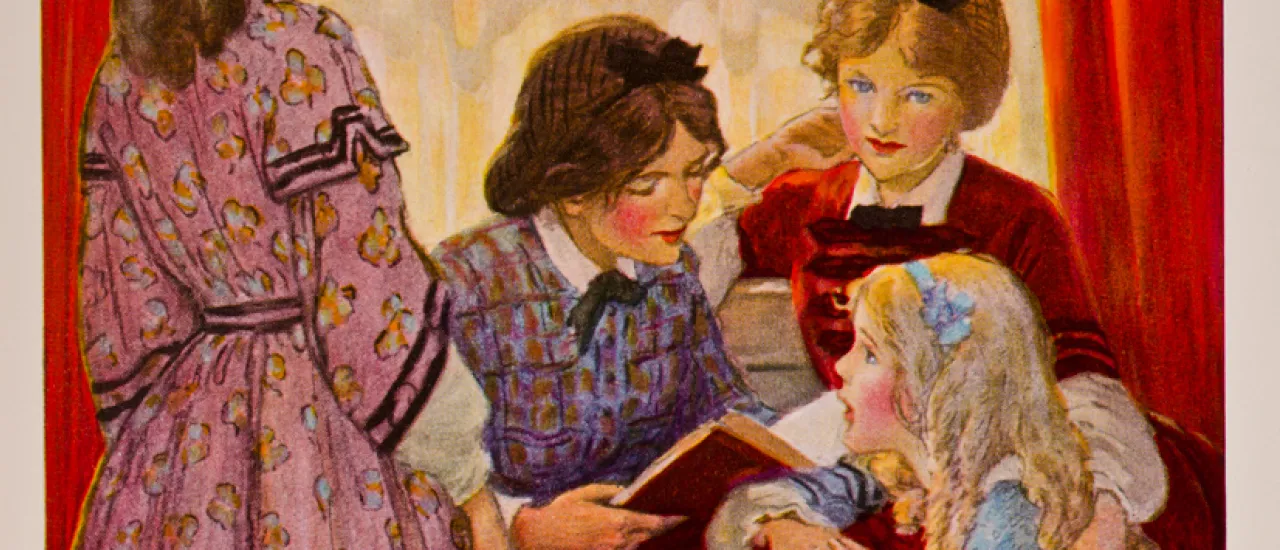
"Little Women", illustration from the book Boys and Girls of Bookland from 1923.
Little Women: Civil War Literature Lesson Plan
A lesson plan for use in middle and high school classrooms.
In 1868 and 1869, Louisa May Alcott published her novel, Little Women. It became an instant bestseller and a classic. The story of the four March sisters opens in Civil War era Massachusetts as the girls grapple with the reality of their father away from home and the struggles of growing up and taking responsibilities. Often seen as semi-autobiographical, Alcott drew on her and her sisters’ own experiences along with her weeks of volunteering in a military hospital in Civil War Washington D.C. The book is often praised for its warm-hearted adventures and misadventures while showing an array of opportunities and hopes for women’s futures.
This Lesson Plan can be used as a prepared resource by following this curriculum plan which aligns to NCSS and Common Core Standards.
This Lesson Plan's assets can also be used on their own as supplemental resources. The display format is prepared for easy access, exploring, and learning.
Civil War Literature Module
Upon completion of this lesson, the students will be able to:
- Knowledge
- Students will be able to briefly describe the home front during the American Civil War.
- Students will also note some of the experiences of young girls on the northern home front.
- Comprehension/Application/Analysis
- Read a summary of Little Women and read an excerpt from the novel; then answer inquiry questions to explore the home front history included in the story.
- Evaluation
- Discuss observations from and about the historic novel and evaluate as a class what it tells us about the American Civil War’s impact on the northern home front.
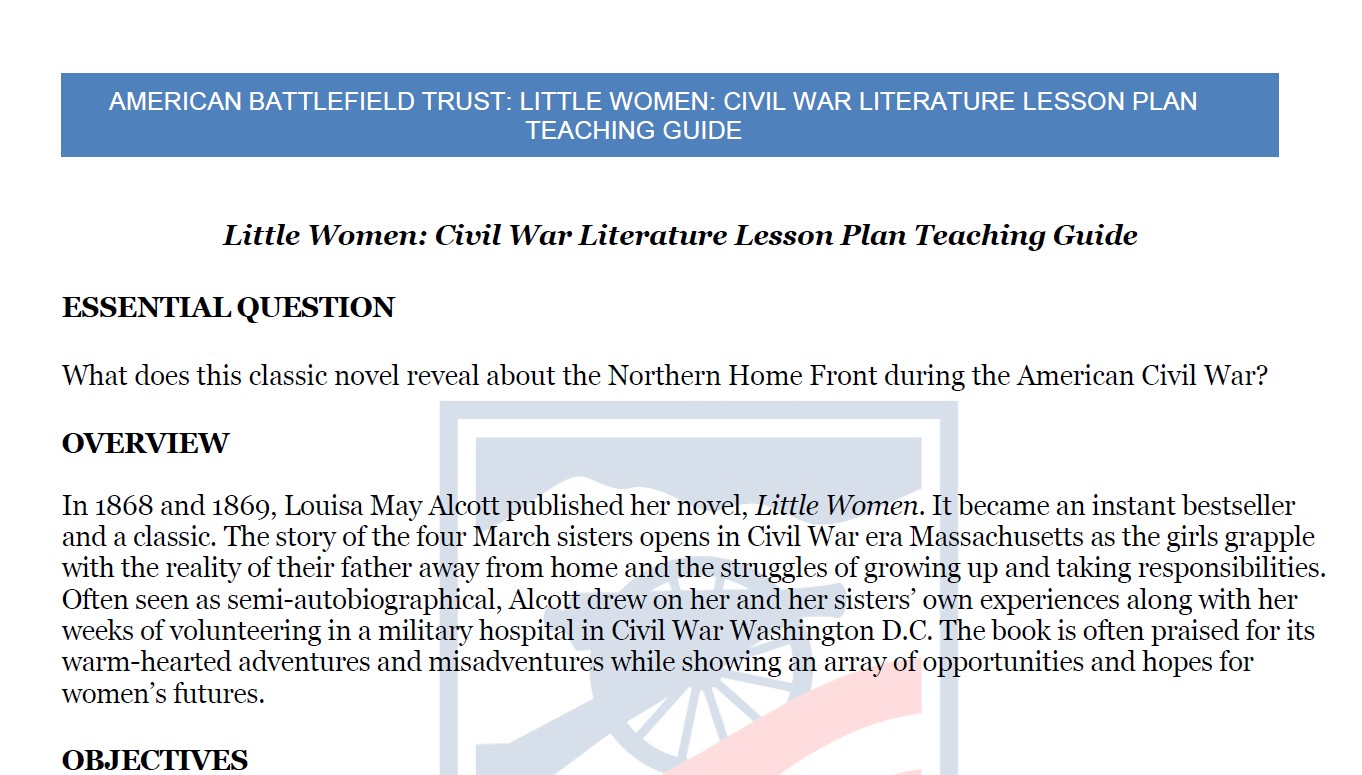
Check out the Lesson Plan Teaching Guide for more instructions on using the prepared Lesson Plan.
Lesson Plan Activity:
- Use the Lesson Plan’s PowerPoint to explore the context and history.
- As a class or in groups read this article Little Women (from Lit Chart) for the story plot and context.
- As a class or in groups, read one of the excerpts from Little Women.
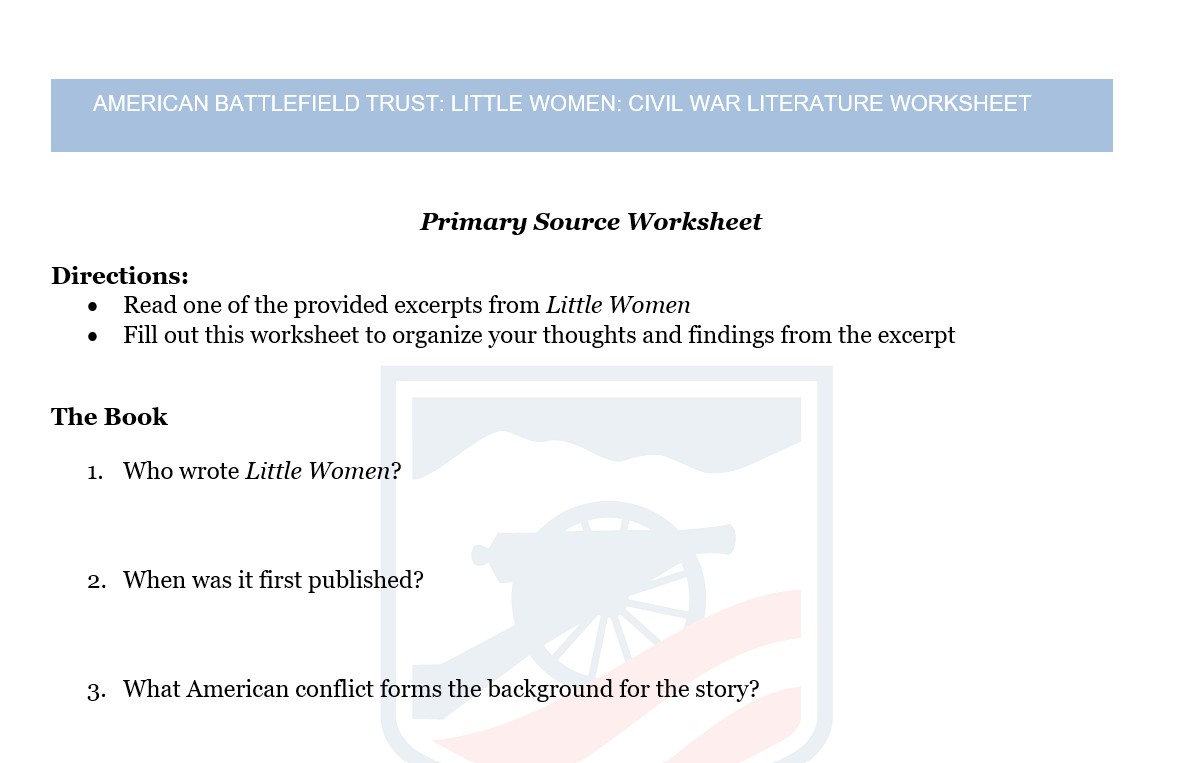
- Distribute the primary source worksheet and have students fill out their answers. (Or use the questions for verbal discussion.)
- Encourage a class discussion about Little Women and literature.
- Is the Home Front part of a war?
- Is the Civil War the focus in Little Women? How does a military or political happening in the “background” affect life?
- What is a coming-of-age story? Do you have a favorite book with this theme?
- From the excerpts (or if you’ve read the book or watched a film version), which March sister is your favorite character? Why?
- Can you think of a “famous” woman from the Civil War era? What did she do during the conflict?
Alcott wrote Little Women for children to read. Do you think war should be included in children’s literature (even in the background)? Why or why not?
OPTIONAL HOMEWORK/ASSESSMENT/ADDITIONAL ACTIVITIES:
Option 1: Louisa May Alcott’s Civil War
Alcott journeyed to Washington DC and worked as a nurse in a military hospital during the winter of 1862-1863. She later wrote about her experiences in stories published under the title Hospital Sketches. Individually or in groups, students can read Chapter 3 from Hospital Sketches and make notes about Alcott’s work, her challenges, and how humor helped her through challenging moments. Then, watch the In4Minute video and compare Alcott’s experiences to examples of other women’s work during the Civil War.
- Hospital Sketches: Chapter 3
- In4Minutes: Women and the Civil War
- “A record of the personal services of our American women in the late Civil War” (extra primary source for comparison)
Common Core State Standards- ELA & History/Social Studies
Grades 6-8
- Key Ideas and Details:
- CCSS.ELA-LITERACY.RH.6-8.2
- Determine the central ideas or information of a primary or secondary source; provide an accurate summary of the source distinct from prior knowledge or opinions.
- CCSS.ELA-LITERACY.RH.6-8.6
- Identify aspects of a text that reveal an author's point of view or purpose (e.g., loaded language, inclusion or avoidance of particular facts).
- CCSS.ELA-LITERACY.RH.6-8.6
- Determine the central ideas or information of a primary or secondary source; provide an accurate summary of the source distinct from prior knowledge or opinions.
- CCSS.ELA-LITERACY.RH.6-8.2
- Integration of Knowledge and Ideas:
- CCSS.ELA-LITERACY.RH.6-8.8
- Distinguish among fact, opinion, and reasoned judgment in a text.
- CCSS.ELA-LITERACY.RH.6-8.8
Grades 9-10
- Key Ideas and Details:
- CCSS.ELA-LITERACY.RH.9-10.1
- Cite specific textual evidence to support analysis of primary and secondary sources, attending to such features as the date and origin of the information.
- CCSS.ELA-LITERACY.RH.9-10.2
- Determine the central ideas or information of a primary or secondary source; provide an accurate summary of how key events or ideas develop over the course of the text.
- CCSS.ELA-LITERACY.RH.9-10.1
- Craft and Structure:
- CCSS.ELA-LITERACY.RH.9-10.5
- Analyze how a text uses structure to emphasize key points or advance an explanation or analysis.
- CCSS.ELA-LITERACY.RH.9-10.5
- Integration of Knowledge and Ideas:
- CCSS.ELA-LITERACY.RH.9-10.8
- Assess the extent to which the reasoning and evidence in a text support the author's claims.
- CCSS.ELA-LITERACY.RH.9-10.8
Grades 11-12
- Key Ideas and Details:
- CCSS.ELA-LITERACY.RH.11-12.2
- Determine the central ideas or information of a primary or secondary source; provide an accurate summary that makes clear the relationships among the key details and ideas.
- CCSS.ELA-LITERACY.RH.11-12.3
- Evaluate various explanations for actions or events and determine which explanation best accords with textual evidence, acknowledging where the text leaves matters uncertain.
- CCSS.ELA-LITERACY.RH.11-12.2
- Craft and Structure:
- CCSS.ELA-LITERACY.RH.11-12.5
- Analyze in detail how a complex primary source is structured, including how key sentences, paragraphs, and larger portions of the text contribute to the whole.
- CCSS.ELA-LITERACY.RH.11-12.5
- Integration of Knowledge and Ideas:
- CCSS.ELA-LITERACY.RH.11-12.8
- Evaluate an author's premises, claims, and evidence by corroborating or challenging them with other information.
- CCSS.ELA-LITERACY.RH.11-12.8
Social Studies - National Council for the Social Studies
- Theme 1: Culture
- Theme 2: Time, Continuity, and Change
- Theme 3: People, Places, and Environments
- Theme 4: Individual Development and Identity
This Lesson plan
contains the following:
3 Activities | 20 Resources
Audience: Middle school | High school