The American Crisis: 1776 Perspectives Lesson Plan
A lesson plan for use in middle and high school classrooms.
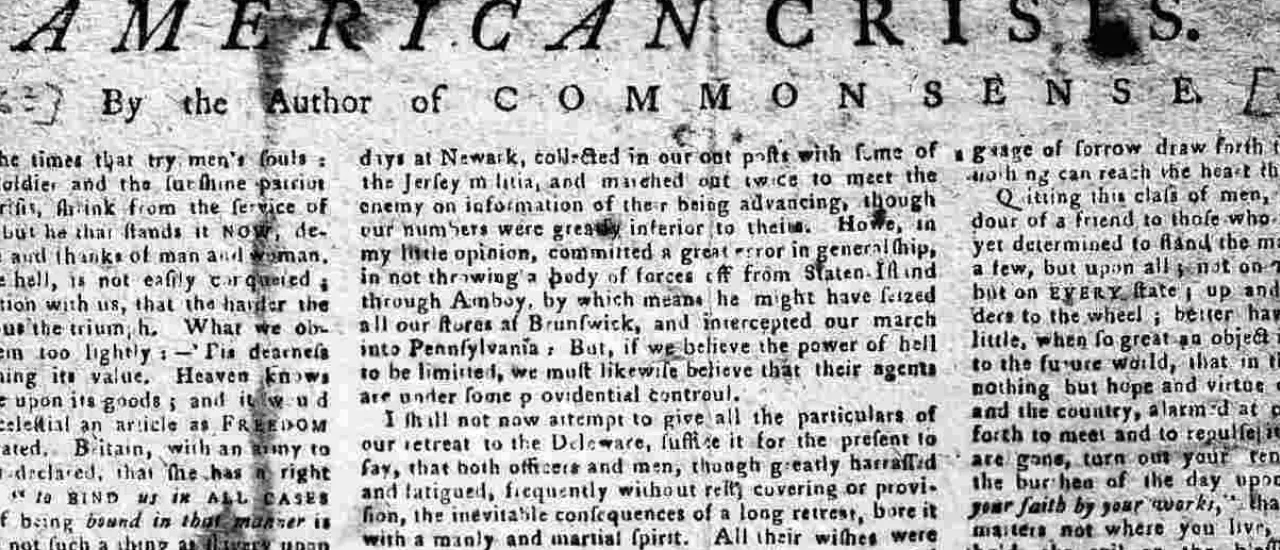
In late November 1776, during the Continental Army’s darkest hour, Paine again picked up the pen with the hope of recreating the enormous success of Common Sense. “It was necessary” he later wrote, that “the country should be strongly animated.” As the wrecked army crawled across New Jersey, Paine took advantage of every stop to put words to paper. He often wrote late into the evenings by the flickering light of a campfire, as exhausted soldiers slept huddled nearby. As Washington’s army crossed the Delaware River into Pennsylvania, he put the finishing touches on his latest pamphlet – The American Crisis No. 1.
First published in Philadelphia on December 19th, The American Crisis No. 1 was an appeal to the patriotism and resolution of the American people. The words electrified the demoralized army and became the rallying cry that Paine had hoped for. Within a day, copies were printed and distributed throughout the Continental Army, and officers read it to their assembled men. Militiamen who had returned home in disgust just a month before took up arms once again. Civilians up and down the Delaware River Valley reaffirmed their commitment to the cause of independence. Desertions among the Continentals slowed, and soldiers quoted The Crisis in their watchwords while on picket duty. On the night of December 25th, as Washington prepared to make a strike on Trenton, he ordered that Paine’s words be read to the entire army as a reminder of the importance of their task.
This Lesson Plan can be used as a prepared resource by following this curriculum plan which aligns to NCSS and Common Core Standards.
This Lesson Plan's assets can also be used on their own as supplemental resources. The display format is prepared for easy access, exploring, and learning.
Upon completion of this lesson, the students will be able to:
1. Knowledge
- Briefly explain the importance of Thomas Paine’s writings during the American Revolution.
2. Comprehension/Application/Analysis
- Read The American Crisis and answer inquiry questions to better understand the document and its influence on the American Revolution.
3. Evaluation
- Discuss findings from primary sources and how Paine’s writings inspired the Americans to continue the fight to independence.

Check out the Lesson Plan Teaching Guide for more instructions on using the prepared Lesson Plan.
Lesson Plan Primary Source Activity
- Use the Lesson Plan’s PowerPoint to explore the context and history.
- As a class or in groups, reading The American Crisis.
- Distribute the primary source worksheet and have students fill out their answers. (Or use the questions for verbal discussion.) There is an answer guide here.
- Encourage a class discussion about The American Crisis.
- Did you find the writing inspiration? Other feelings?
- Are there other times in U.S. History that this might be inspirational?
- Have you heard the phrase “the pen is mightier than the sword”? Do you think that is true with Paine’s writings?
- Did you have a favorite quote from The American Crisis? Why?
- Paine’s writing brought people together to support the American cause. Do you think writing (or other forms of communication) can still unite people today? Why or why not?
OPTIONAL HOMEWORK/ASSESSMENT/ADDITIONAL ACTIVITIES:
Option 1: Comparing Common Sense and The American Crisis
Compare and contrast two of Thomas Paines’s most famous writings. Common Sense inspired Americans to seriously consider independence from Britain and The American Crisis motivated American soldiers to continue fighting for that independence.
Watch the short videos and read the primary source documents (or excerpts since they are long documents). Next in groups or as a class, create a Venn Diagram. What is similar and what is different between the two documents? These questions can be used as starting points:
- Who is the author?
- What is the purpose of each pamphlet?
- When were the pamphlets first published?
- What were the results/impact of the pamphlets?
- What was happening at the same time the pamphlets were created?
Option 2: The Situation
Take a closer look at the difficult situation the American army and cause faced by the beginning of December 1776. These primary sources include details of situation before the Ten Crucial Days. Divide the students into groups and have them read one primary source, taking notes on adjectives and other descriptions included. In a class discussion, have each group share a summary of their source with who, where, when, what details and then a conclusion about the situation from this source’s perspective.
Common Core State Standards- ELA & History/Social Studies
Grades 6-8
- Key Ideas and Details:
- CCSS.ELA-LITERACY.RH.6-8.1
- Cite specific textual evidence to support analysis of primary and secondary sources.
- CCSS.ELA-LITERACY.RH.6-8.2
- Determine the central ideas or information of a primary or secondary source; provide an accurate summary of the source distinct from prior knowledge or opinions.
- CCSS.ELA-LITERACY.RH.6-8.1
- Craft and Structure:
- CCSS.ELA-LITERACY.RH.6-8.6
- Identify aspects of a text that reveal an author's point of view or purpose (e.g., loaded language, inclusion or avoidance of particular facts).
- CCSS.ELA-LITERACY.RH.6-8.6
- Integration of Knowledge and Ideas:
- CCSS.ELA-LITERACY.RH.6-8.8
- Distinguish among fact, opinion, and reasoned judgment in a text.
- CCSS.ELA-LITERACY.RH.6-8.8
Grades 9-10
- Key Ideas and Details:
- CCSS.ELA-LITERACY.RH.9-10.1
- Cite specific textual evidence to support analysis of primary and secondary sources, attending to such features as the date and origin of the information.
- CCSS.ELA-LITERACY.RH.9-10.2
- Determine the central ideas or information of a primary or secondary source; provide an accurate summary of how key events or ideas develop over the course of the text.
- CCSS.ELA-LITERACY.RH.9-10.3
- Analyze in detail a series of events described in a text; determine whether earlier events caused later ones or simply preceded them.
- CCSS.ELA-LITERACY.RH.9-10.1
- Craft and Structure:
- CCSS.ELA-LITERACY.RH.9-10.5
- Analyze how a text uses structure to emphasize key points or advance an explanation or analysis.
- CCSS.ELA-LITERACY.RH.9-10.6
- Compare the point of view of two or more authors for how they treat the same or similar topics, including which details they include and emphasize in their respective accounts.
- CCSS.ELA-LITERACY.RH.9-10.5
- Integration of Knowledge and Ideas:
- CCSS.ELA-LITERACY.RH.9-10.8
- Assess the extent to which the reasoning and evidence in a text support the author's claims.
- CCSS.ELA-LITERACY.RH.9-10.9
- Compare and contrast treatments of the same topic in several primary and secondary sources.
- CCSS.ELA-LITERACY.RH.9-10.8
Grades 11-12
- Key Ideas and Details:
- CCSS.ELA-LITERACY.RH.11-12.1
- Cite specific textual evidence to support analysis of primary and secondary sources, connecting insights gained from specific details to an understanding of the text as a whole.
- CCSS.ELA-LITERACY.RH.11-12.2
- Determine the central ideas or information of a primary or secondary source; provide an accurate summary that makes clear the relationships among the key details and ideas.
- CCSS.ELA-LITERACY.RH.11-12.3
- Evaluate various explanations for actions or events and determine which explanation best accords with textual evidence, acknowledging where the text leaves matters uncertain.
Craft and Structure:
- Evaluate various explanations for actions or events and determine which explanation best accords with textual evidence, acknowledging where the text leaves matters uncertain.
- CCSS.ELA-LITERACY.RH.11-12.6
- Evaluate authors' differing points of view on the same historical event or issue by assessing the authors' claims, reasoning, and evidence.
- CCSS.ELA-LITERACY.RH.11-12.1
- Integration of Knowledge and Ideas:
- CCSS.ELA-LITERACY.RH.11-12.8
- Evaluate an author's premises, claims, and evidence by corroborating or challenging them with other information.
- CCSS.ELA-LITERACY.RH.11-12.9
- Integrate information from diverse sources, both primary and secondary, into a coherent understanding of an idea or event, noting discrepancies among sources.
- CCSS.ELA-LITERACY.RH.11-12.8
Social Studies - National Council for the Social Studies
- Theme 2: Time, Continuity, and Change
- Theme 3: People, Places, and Environments
- Theme 5: Individuals, Groups, and Institutions
This Lesson plan
contains the following:
3 Activities | 14 Resources
Audience: Middle school | High school