Dragging Canoe

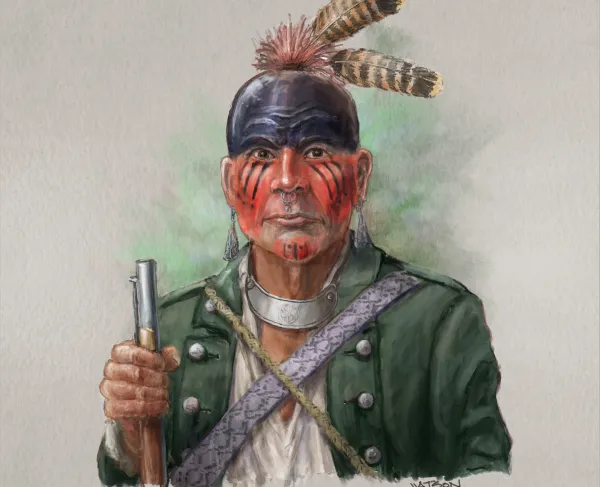
Born sometime around 1738 Dragging Canoe, or Tsiyu Gansini in the Cherokee language, was a prominent leader of the Cherokee people during the American Revolution. His father Attakullakulla, who was often called Little Carpenter, was the leading Cherokee diplomat in the years leading up to the Revolutionary War. According to legend, Dragging Canoe earned his name as a young boy, while trying to prove his worthiness to join a war party by carrying one of their canoes. He only had the strength to drag it along the ground.
In the early 1770s, Dragging Canoe was one of many Native American leaders concerned with the threat of white settlers’ encroaching of their lands. At the start of the American Revolution, British imperial agents sought to mobilize Native American warriors to attack colonial frontiers. Dragging Canoe and the rest of the Cherokee launched a three-pronged attack on settlements in what is now Tennessee in July 1776. Dragging Canoe was wounded at the Battle of Island Flats on July 20, 1776.
The Cherokee attack failed to dislodge the settlers. In response colonists from Virginia, North Carolina, South Carolina, and Georgia, with some support from the Continental Army, coordinated an invasion of Cherokee territory. In the fall of 1776, Americans destroyed numerous Cherokee villages, along with stores of food. This assault convinced Attakullakulla and other Cherokee leaders to try and make peace with the colonists. They negotiated treaties with the colonies that ceded large tracts of land and promised not to engage in any further hostility. However, Dragging Canoe rejected the treaties and led a faction of the Cherokee to resettle along Chickamauga Creek, near the site of modern Chattanooga. Dragging Canoe’s community of Cherokee became known as the Chickamauga.
Dragging Canoe and the Chickamauga Cherokee were relentless enemies of the Americans during the Revolutionary War. Their main targets were the settlements in eastern and middle Tennessee, including Fort Nashborough (modern Nashville). On April 2, 1781, at the Battle of the Bluffs, the Chickamauga almost succeeded in destroying the outpost, but Americans repulsed their attack.
After the Revolutionary War, Dragging Canoe continued to lead the Chickamauga Cherokee, also referred to as the Lower Cherokee, in opposition to the westward expansion of the new United States. He died on March 1, 1792, in the town of Running Water. His successor in the role of leadership for the Chickamauga Cherokee, John Watts, would ultimately make peace with the United States in 1794.