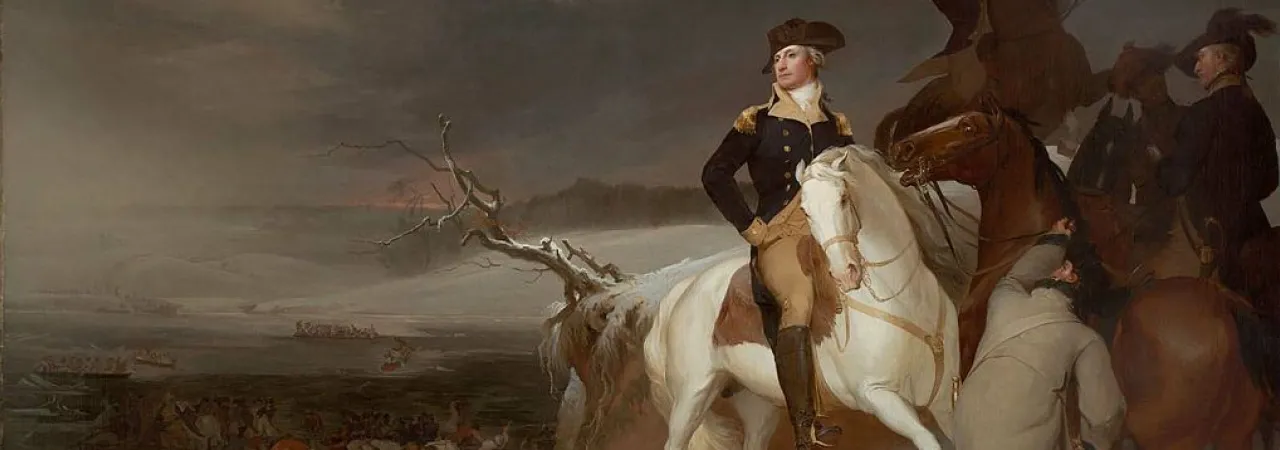
Passage Of The Delaware by Thomas Sully, 1819
On the night of December 25, 1776, George Washington and the Continental Army crossed the Delaware River and as the next morning dawned attacked Hessian soldiers at the village of Trenton. It became a key moment in the American Revolution and memorable, even legendary, battle in U.S. History, giving Washington a much-needed victory to capstone the year when independence had been declared. However, Washington usually did not cross a freezing river and lead a surprise attack on Christmas night. His Christmas activities and celebrations typically reflected the experiences of other men of his social rank in the colony and state of Virginia. George Washington’s Christmases offer a glimpse into the holiday’s past in American history through scenes at home, battlefield, and executive office.
By the mid-18th Century, Christmas had both religious meaning and social traditions. Not all settlers in the British North American colonies observed the holiday, but the upper class Virginians with their Anglican religious background celebrated Christmas – often for twelve days. Following church tradition, December 25 marks the birth of Jesus Christ and January 6 (Epiphany Day) ends the twelve days with a commemoration of the Magi’s arrival to see the baby. Religious services often marked these particular days, and in English tradition the twelve days included a festive atmosphere with hanging greenery, special foods, long visits from or to family and friends, dances, fox hunts, music, and other activities. Sometimes the enslaved population received tokens of money or a day or two reprieve from some tasks; in some of his writings, George Washington noted when the “days off” ended for the enslaved people at Mount Vernon. Unlike Christmas celebrations in the modern era, gift-giving was not a widespread custom, though some families gave small gifts on New Year’s Day. Christmas trees did not become part of English or American tradition until the 19th Century.
Before the American Revolution, George Washington’s Christmases varied. Perhaps there were happy childhood Christmas moments, but history recorded the difficult year in 1740 when the Washington family home at Ferry Farm burned down, and they spent a “cheerless” Christmas crowded into a kitchen building. In 1751, he and his older half-brother Lawrence spent the holiday enjoying a dinner of roasted goose aboard a ship, returning from the Barbadoes. Two years later, Washington had a less pleasant Christmas trudging through the freezing wilderness as he return from carrying messages to the French in the Ohio River Valley. On the Twelfth Day of Christmas on January 6, 1759, George Washington married Martha Dandridge Custis.
Notes in Washington’s diary ten years later in 1769 give a glimpse of traveling and family visits during the Christmas season. The Washington Family departed from Williamsburg – the Virginia colonial capital – on December 21 after the assembly’s adjournment. They traveled north, stopping to dine or stay with family and friends as they made their way through the plantation lands and towns of the Tidewater region; they arrived home at Mount Vernon on December 28, had some time to rest, and then hosted their own holiday dinner on January 6. In the early 1770s, George Washington was frequently at home for the holidays, spending his time riding, dining, attending church, and fox hunting.
Washington spent the Christmases of the American Revolution (1775-1783) away from Mount Vernon. Appointed commander of the Continental Army in 1775, he spent that year’s Christmas at the siege lines around Boston, though Mrs. Washington hosted a grand Twelfth Night party at headquarters. In 1776, Washington prepared for the Continental Army to cross the Delaware River on Christmas night and surprise a village of Hessian troops at Trenton, New Jersey. The American victory boosted morale and launched the campaign known as the Ten Crucial Days, which included another American victory at Princeton. By Christmas 1777, the Continental Army had scrambled through the Philadelphia Campaign and started constructing huts for their winter encampment at Valley Forge, Pennsylvania. The next winter Washington stayed at Middlebrook, New Jersey. Throughout the winters with the Continental Army, Martha Washington visited and stayed, sometimes hosting Christmas festivities if she arrived before the holidays. By Christmas 1779, Washington was encamped at Morristown, New Jersey, and that winter was particularly harsh for the Continental Army; General Washington tried to make Christmas lively by hiring a band to play music on December 25. New Jersey again hosted the winter camps in 1780. Following a British army’s surrender at Yorktown, Virginia, in 1781, the Washington’s Army returned north and spent the next two winters in the New Jersey and New York with Washington’s headquarters at Newburgh, New York. On Christmas Day 1781, though, General and Mrs. Washington were in Philadelphia, staying with their friend Robert Morris and still mourning the loss of Martha’s son, Jacky.
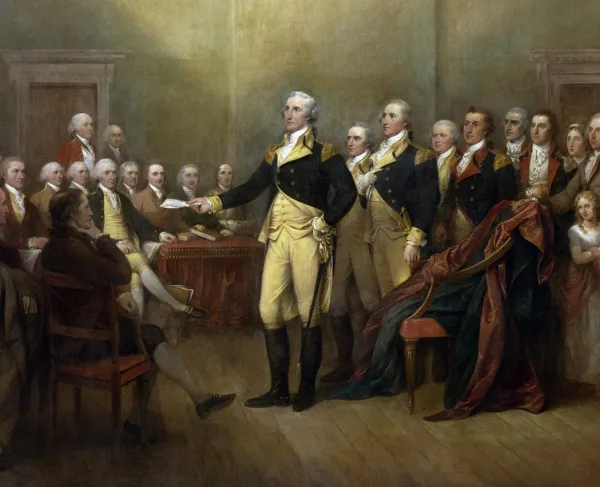
With the 1783 Treaty of Paris ended the Revolutionary War and securing the United States independence, the Continental Army disbanded and George Washington resigned his military commission on December 23, 1783. The Congress met in Annapolis, Maryland, at that time and after the honors, speeches, symbols, and voluntary resignation of military power, Washington headed for Mount Vernon. He arrived on Christmas Eve 1783 and spend the holiday season with his wife and grandchildren. A niece wrote, “The Gen’l seemed very happy and Mistress Washington was from Daybrake making everything agreeable as possible for Everybody.” Settling back to peacetime routines, Washington spent the next few Christmases hosting guests and fox hunting.
Elected President of the United States and taking the oath of office in 1789, George Washington and his family moved back into public life. The first president knew that he was setting precedents and stayed carefully aware of his image. The first presidential Christmas was celebrated in New York City with a visit to St. Paul’s Church and Mrs. Washington’s afternoon reception for visitors. In 1790, the Washingtons and the seat of government had relocated to Philadelphia, and the Washingtons hosted a dinner for about twenty guests on Christmas Eve. A guest noted, “The dishes were placed all around, and there was an elegant variety of roast beef, veal, turkeys, ducks, fowls, hams, etc. puddings, jellies, oranges, apples, nuts, almonds, figs, raisins, and a variety of wines and punch.”
For Christmas 1797, George and Martha Washington were back at Mount Vernon, retiring to private life after eight years in executive office and mansions. The couple seemed to have spent a quieter Christmas, and the former general and present caught up on his correspondence. He included this holiday salutation in a letter to extended family: “We, remain in Statu quo, and all unite in offering you, & yours, the compliments of the season; and the return of many, many more, and happy ones.” Washington’s last Christmas, in 1798, was likewise quiet, and he died on December 14, 1799.
George Washington celebrated Christmas and sometimes that holiday season became part of pivotal moments – like staging the Battle of Trenton during the American Revolution. While he did not seem to start any new Christmas traditions as president, he kept Christmas and offered executive precedent for a Christmas dinner and gatherings at the president’s mansion.

Related Battles
5
905