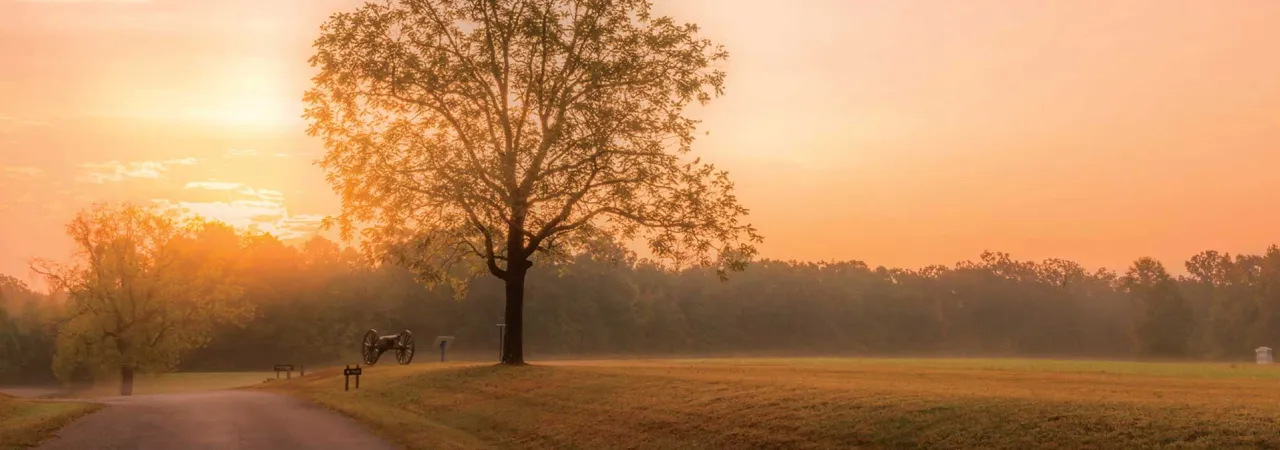
Shiloh National Military Park, Tenn.
Preserve 127 Historic Acres Across Tennessee, Georgia & Alabama
The Opportunity
This one is going to be down to the wire. Right now, 127 acres spread across four battlefields in the Western Theater are ready to be preserved. Five properties total. Together, they span the Civil War.
The value of these properties tops $7.5 million. But thankfully, a number of generous partners, grants, and one significant landowner contribution have brought this effort achingly close to the finish line. Only $196,000 remains to save all this hallowed ground forever.
Two of the five properties close in the next 60 days, so we must move quickly.
There may not be much time, but the good news is that you can make one gift today and have your generosity matched $39-to-$1 while helping to save land at these four irreplaceable battlefields:
- Shiloh and Stones River in Tennessee
- Dallas in Georgia, and
- Spanish Fort in Alabama.
The History
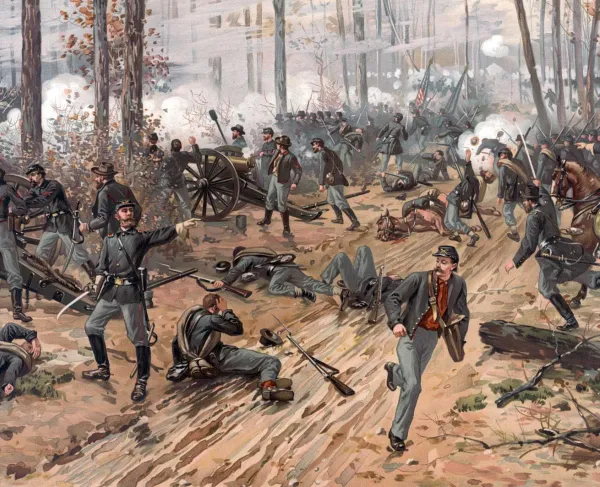
The Battle of Shiloh
By the early spring of 1862, the Western Theater of the Civil War had become a bright spot for the North. Victory at Fort Henry, the Confederate surrender at Fort Donelson, the capture of Nashville, along with massive territory gains west of the Mississippi, had forced Confederates to come to terms with the major disadvantages they faced in the west.
Their numbers were smaller. But their hopes remained high. Confederate Gen. Albert Sidney Johnston believed a surprise attack could work against Union Gen. Ulysses S. Grant and his men, who had gathered on the banks of the Tennessee River at a spot called Pittsburg Landing.
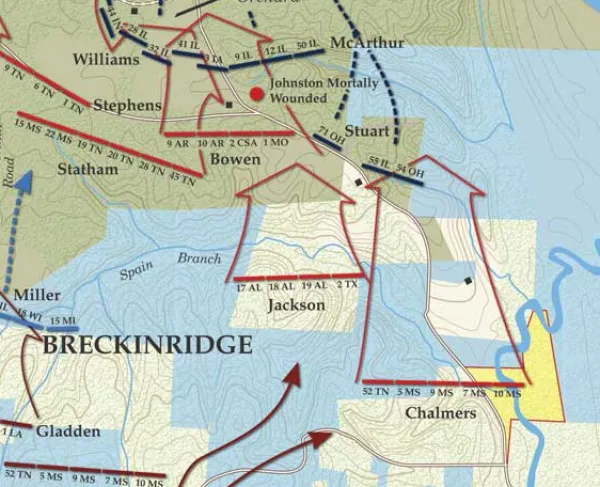
Those early hours at Shiloh were a close call. Johnston and his Confederate troops got off to a rocky start but still managed to drive back a large part of Grant’s army. The fighting lasted all through the first day of battle, but Johnston was mortally wounded and Grant was able to stabilize his line. Reinforced, Grant’s plan was to “Attack at daylight and whip them.” He struck back the next morning, inflicting a terrible defeat upon the Confederates. Casualties exceeded 23,700, making the fighting that began at Pittsburg Landing the costliest in United States history up to that point — by far.
The two tracts we’re fighting to save at Shiloh were right at the heart of the action on that first day of fighting. Together, they total nearly 32 acres. Both border battlefield acres you and I have already saved. In fact, the Trust has saved most of this section of the battlefield over the years.
The Battle of Stones River
Almost nine months later, at Stones River, Tennessee, fierce fighting broke out just a few days after Christmas. And just like at Shiloh, it was initially a close call.
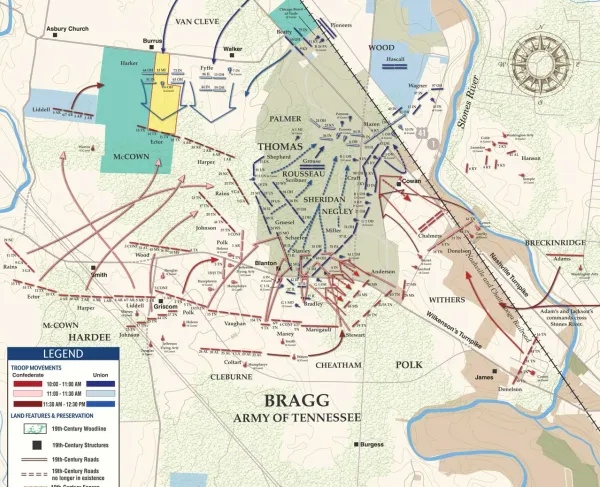
The night before the battle, on December 30, 1862, the two armies gathered near Murfreesboro within a half mile of one another, with Confederate Gen. Braxton Bragg and his Confederate Army of Tennessee holding the advantage.
Both he and Union Gen. William Rosecrans planned to strike his opponent’s right flank — but while Rosecrans’ army had to cross Stones River to accomplish this goal, the Confederates faced no such obstacle.
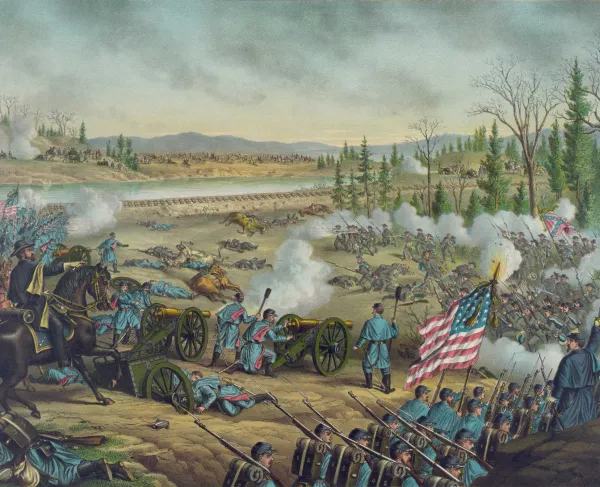
Bragg launched a hammerlike attack that drove back Rosecrans’ stubborn force. But just like earlier that year at Shiloh, these U.S. forces were able to regroup in a solid line of blue, with muskets and powerful artillery blazing. Bragg’s forces tried but failed to make further gains, and their early momentum was lost. The Union troops eked out a victory at Stones River, which boosted morale in the North and gave the Federals control of Middle Tennessee. It didn’t come without a cost, however — of all the major battles in the Civil War, Stones River had the seventh- highest number of casualties, nearly exceeding the losses at Shiloh, and a staggering 32% casualty rate for those involved.
This tract at Stones River, which consists of 30.5 acres, witnessed Union and Confederate combat and maneuvers on the morning of the first day. It is also adjacent to land you and I are already working to preserve!
By saving this land, there could be an opportunity to connect previously saved battlefield land with trails and install additional on-site Interpretation.
The Battle of Dallas, Georgia
Fast forward nearly 17 months from the Battle of Stones River. Vicksburg had fallen, Chattanooga had been captured by Union forces, Gen. Grant was in command of all U.S. armies, and Gen. Bragg had been removed from Confederate command.
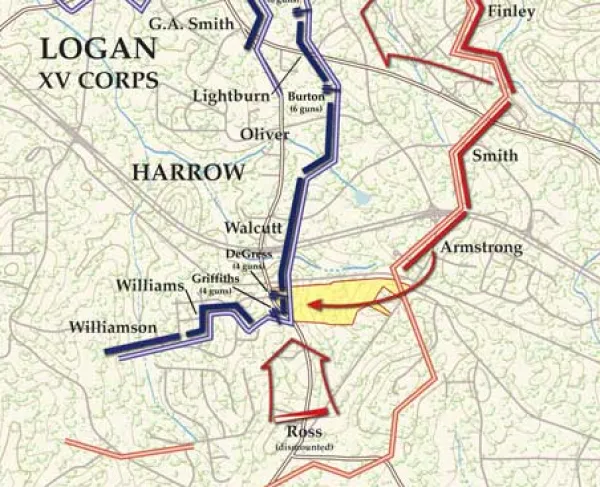
On May 28, 1864, Confederate Gen. Joseph E. Johnston was trying to halt Gen. William T. Sherman's advance toward Atlanta. Johnston hoped he had the chance for victory against what he believed was a weakened Union flank in motion at Dallas, Georgia.
Despite some initial Confederate success, the Federals had more men and beat back early assaults before inflicting a three-to-one casualty rate on those in the main Southern assault. The Confederates lost another chance to regain momentum in the Western Theater.
Captain Francis DeGress’s four-gun Battery H, 1st Illinois Light Artillery, occupied the ridgeline position on the target property. The still-visible infantry trenches around DeGress’s battery were dug and occupied by Illinois, Indiana, Iowa, and Ohio regiments of the Fourth Division, XV Corps.
The Battle of Spanish Fort and Fort Blakely
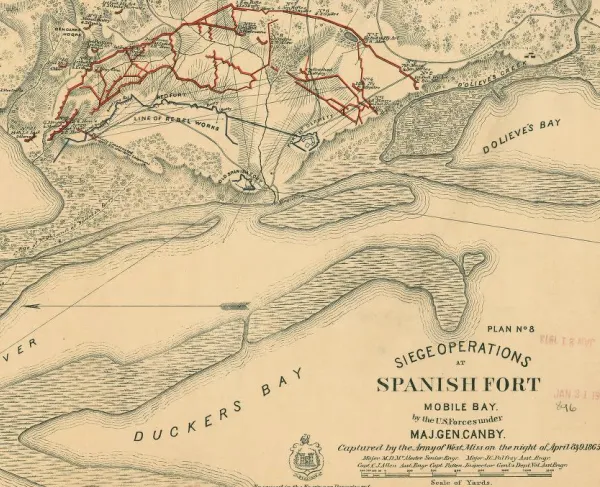
Finally, we turn to our fifth and final tract at Spanish Fort, Alabama. In 1864, Confederate hopes to turn the tide had been dimming. Mobile Bay and the City of Atlanta had fallen to Union forces, and Gen. Grant was besieging Petersburg and Richmond. President Lincoln was reelected, ensuring a fight to the finish. Gen. John Bell Hood met disaster in Middle Tennessee. In early 1865, Sherman marched northward through the Carolinas with impunity and beat Johnston at Bentonville. Richmond and Petersburg were on the brink of falling to Federal forces, and Gen. Robert E. Lee's vaunted army began to melt away.
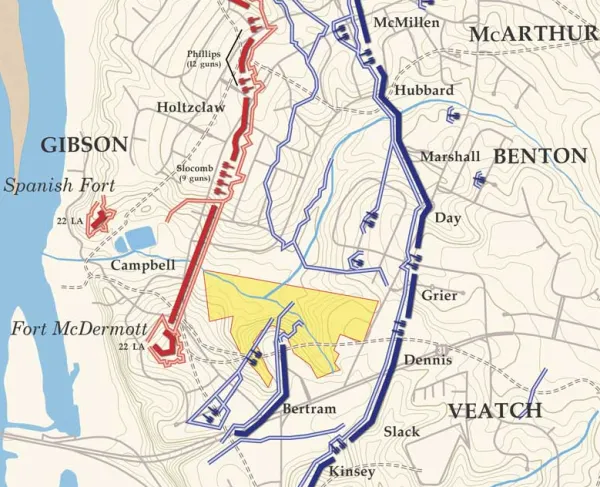
Still, the fighting was not over. Union troops sought to capture the city of Mobile, Alabama, and drive the rebels out of their final strongholds on the Gulf Coast. Confederate forces at Spanish Fort and Fort Blakely were outnumbered as much as six- to-one but were determined to protect the city.
After nearly two weeks of maneuvers and engagements from March 27–April 9, the Union forces took both forts, and Mobile’s mayor surrendered the city without a fight soon after.
With the fall of Mobile, the final outcome of the Civil War was only a question of time. The Confederates would soon surrender; the Union remained intact; and an uneasy process of healing could begin.
But another battle for this 45-acre tract is still raging today. In fact, some of the property nearly became a Walmart! Only a late change in plans by the developer has given us the opportunity to save more land than we anticipated — The Trust’s first saved land at Spanish Fort, and a huge win for preservation.
Make History at These Four Battlefields
Please make your best gift now to help save these battlefield lands, knowing the value of your support will be multiplied 39 times.
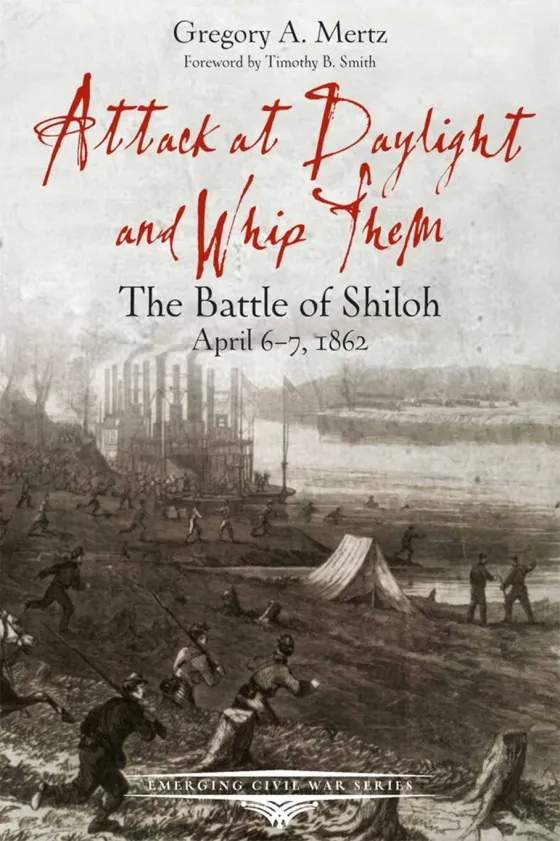
Give $62 or more now, and you’ll receive your own copy of Attack at Daylight and Whip Them: The Battle of Shiloh, April 6–7, 1862, by historian Gregory A. Mertz. Mertz grew up on the Shiloh battlefield, and his book taps into five decades of study and perspective!