New Study Finds Visitation to Historic Battlefield Parks Supports $1.5 Billion in Annual Spending
Jared Herr, jherr@battlefields.org
(202) 367-1861 (select option 3)
(Washington, D.C.) — Historic battlefields across the United States support more than 15,000 jobs and $1.5 billion in visitor spending each year, according to a new study that incorporates cell phone tracking and National Park Service visitor data to thoroughly assess the economic power of these preserved battlefield parks and historic sites.
The study, titled Battlefields Mean Business, reflects the popularity of America’s hallowed battlegrounds and their economic benefits for surrounding communities: 20.3 million annual visits to national battlefield sites spanning conflicts and stretching across 31 states and two territories amounted to $1.5 billion in direct spending and $2.2 billion in total economic output. The economic and visitor analysis was conducted by market research firm RRC Associates for the American Battlefield Trust.

“Battlefields Mean Business demonstrates what we have long known to be true: America’s battlefield sites are more than places of historical memory. They are economic drivers and recreational destinations that collectively support their local communities,” said David Duncan, president of the American Battlefield Trust. “Historic preservation fuels a ‘power of place’ that draws a loyal visitor base to these landscapes again and again.”
The patterns and information that emerged from this analysis clearly demonstrate that the significance of these sites extends beyond their historical period and into the 21st century. The findings will provide insights for improving how these destinations are managed, interpreted and marketed, as well as indicating where investments in infrastructure and programming may be most beneficial. The study examined data from 2024, the most recent year available.
Among the key findings in Battlefields Mean Business:
- Battlefield visitation generates economic value across a spectrum of site types, from high-volume urban destinations to low-volume rural sites.
- Smaller sites actually pack a bigger per-visitor punch and provide valuable economic drivers their communities might not have otherwise.
- More than 20.3 million people visited battlefield parks in 2024, a network spread across virtually all regions of the nation.
- Battlefields function as part of broader tourism systems, often extending visitor trips and increasing regional spending and cumulative impact in the heritage sector.
- Preservation fuels economic contributions. When access to the battlefield increases or interpretive offerings are improved, it can entice visitors to stay longer and increase spending.
- Beyond attracting visitors from afar, battlefields are important community assets regularly and recurringly used by local residents.
Four of the top five battlefield sites for economic output are high-visitation sites located in urban areas. These include destination parks, like top generator Pearl Harbor National Memorial in Hawaii, which supported an estimated 2,896 jobs and over $500 million in economic output in the regional economy, and recreational assets like Kennesaw Mountain National Battlefield Park, outside Atlanta, which supported 1,155 regional jobs and $159 million in economic output. At smaller and more rural sites, visitation has even greater proportional impact, with each 1,530 visitors supporting an individual job, versus 2,050 at larger ones. Thus, in rural Montana, visitors to the Big Hole National Battlefield and Little Big Horn National Monument jointly support 124 jobs in Big Sky Country.
A key innovation of this study was the incorporation of mobile location data to better understand visitation patterns at a subset of 15 battlefield sites. Traditional visitation data sources often face limitations in accurately capturing use at dispersed or open-access sites, where visitors may enter from multiple points and where formal counting infrastructure may be limited or absent. Mobile location data provide a complementary source that enables observation of aggregate visitation patterns, including visitor origins, travel distances, trip frequency, dwell time and connections between battlefield sites and surrounding destinations.
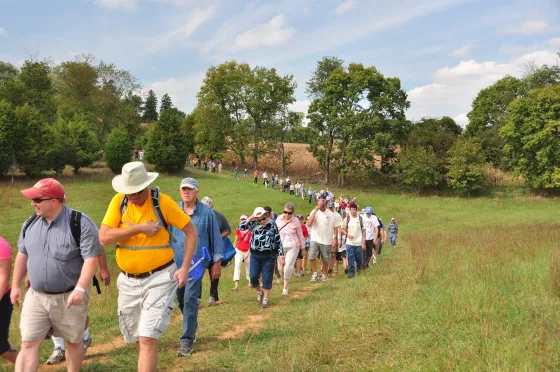
The analysis of mobile location data provided greater site-level insight that broad economic estimates alone cannot capture. The anonymized data, derived from apps that use location services, reveals that most battlefield sites primarily serve local and regional visitors. Dwell times and seasonal patterns vary considerably by site type and geography. Visitor behavior within sites reflects both the commemorative and recreational functions these places serve.
The findings of this study will be useful to park managers and others who work every day for preservation and to expand visitation.
“This study reinforces that preservation is not just about history – it’s about how battlefield landscapes are fundamental to the livelihood of surrounding communities,” said Duncan. “They attract outside spending and become resources for residents, providing tangible benefits without placing a heavy burden on taxpayers. We must continue investing in the protection and interpretation of these hallowed grounds, for both their cultural significance and the economic vitality they provide.”
The American Battlefield Trust is dedicated to preserving America’s hallowed battlegrounds and educating the public about what happened there and why it matters today. The nonprofit, nonpartisan organization has protected more than 62,000 acres associated with the Revolutionary War, War of 1812 and Civil War across 160 sites in 25 states. Learn more at www.battlefields.org.
###
Related Content