Celebrating Flag Day Where the Star-Spangled Banner Was Born
(Baltimore, Md.) — Each June 14th, America marks the anniversary of the Second Continental Congress adopting the Stars and Stripes as our national flag — and few places celebrate it better than Fort McHenry. This year, the Fort McHenry National Monument and Historic Shrine hosted a free Flag Day celebration that drew more than 1,300 visitors.
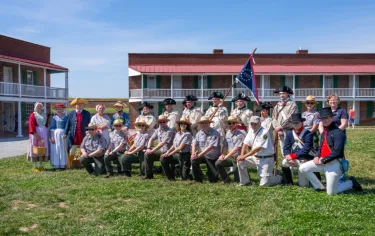
Staff and living historians at Fort McHenry National Monument and Historic Shrine for Flag Day.
Dave JohnsonFor many, Fort McHenry is synonymous with the American flag. During the War of 1812, British forces set their sights on Baltimore after burning Washington, D.C. On September 13, 1814, their warships unleashed a bombardment of the fort that lasted through the night. More than 1,500 bombs and rockets were launched, but the fort was only lightly damaged thanks to earlier fortification efforts. By morning, the assault had failed, and the British abandoned their advance on Baltimore.
Francis Scott Key, an American lawyer held aboard a British ship during the siege, feared the fort had fallen. When he spotted the large garrison flag flying over Fort McHenry on the morning of September 14, he was so moved that he wrote a poem, “Defense of Fort McHenry.” The poem was later set to music and renamed “The Star-Spangled Banner.” It became the official national anthem in 1931.
This Flag Day, 212 years after that famous attack on Fort McHenry, the National Park Service marked the occasion with programs that brought that history to life. Visitors watched living historians assemble a replica of the original 15-star, 15-stripe flag, and learned how flags were made, what materials were used and how the design evolved over the course of American history. Living history youth employees dressed in Revolutionary War-era attire greeted visitors during the morning flag change. As part of the Department of the Interior’s Great American Expedition — an initiative dedicated to highlighting stewardship that celebrates America's first 250 years — the official Expedition pennant flag was also presented at the fort. The event was a fitting tribute to the banner that has flown over this nation since its earliest conflicts.