New Orleans | Jan 8, 1815
The Opportunity
Preserve some of the most important acres from the War of 1812 that we will EVER be able to save! This is likely the LAST and certainly the LARGEST piece of the Battle of New Orleans we’ll ever get the chance to save.
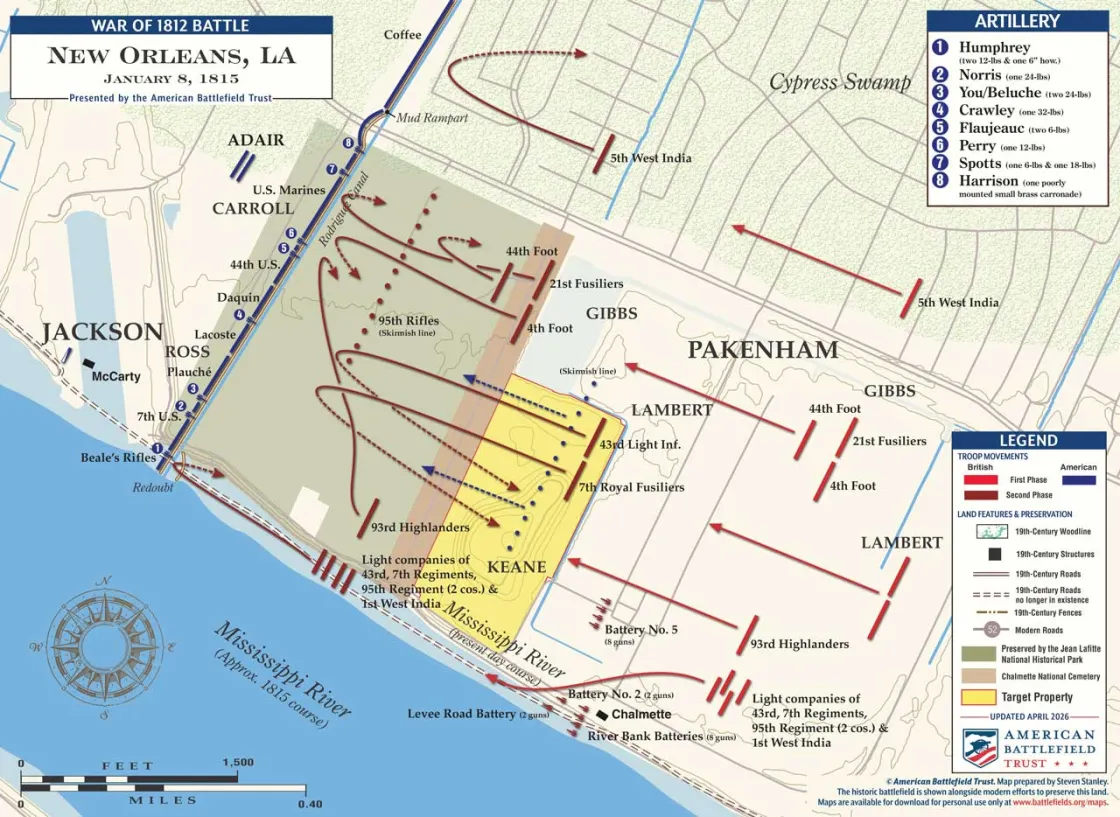
These 40 acres are facing an extraordinary threat. The tract is zoned for heavy industrial use, and if we don’t save it now, it will most certainly be developed for that purpose and lost forever.
This land is adjacent to a National Cemetery where soldiers from the War of 1812, the Civil War, and even the Vietnam War are buried, making this property even more important to our history and for those who fought and died.
The total cost is $3.6 million, but thanks to early commitments from a few donors plus anticipated state and federal grants, the amount we need to raise is less than one-third the total cost — $1,006,582. Every dollar you give will be multiplied in impact $4-to-$1!
Want to learn more? Visit this page for more information and history related to this campaign.
The History
The Battle of New Orleans was the climactic engagement of the War of 1812 and one of the most decisive American victories in the nation's early history.
Despite their recent defeat at Baltimore, the British believed that capturing New Orleans and controlling the Mississippi River would give them a stranglehold on American trade and transportation in the West. They gathered their forces on the lands of Chalmette Plantation, the site of the British position during the battle.
This tract offers an opportunity to interpret the battlefield from the British perspective and help complete the story of the battle. Adjacent to land preserved by the National Park Service at Jean Lafitte National Historical Park and Preserve, it has been a top preservation priority since the park was created in 1939.
During the campaign, American and British forces maneuvered across and around the property. After establishing defensive works along the Rodriguez Canal – known as “Line Jackson” – American forces successfully repelled British attacks.
On January 8, 1815, British troops under Gen. Sir Edward M. Pakenham advanced toward Jackson’s position and came under devastating artillery fire. In less than 30 minutes, the British suffered roughly 2,000 casualties, including Pakenham himself, forcing them to abandon the assault.
The British withdrew from New Orleans soon afterward. News of Andrew Jackson's victory reached Washington before word arrived that the Treaty of Ghent had already ended the war, cementing the battle's place in American memory.
Preserve some of the most important acres from the War of 1812 that we will EVER be able to save! This is likely the LAST and certainly the LARGEST...
Related Battles
71
2,034