2026 Prize for History: Remarks from Winner Rick Atkinson
Rick Atkinson accepts the 2026 American Battlefield Trust Prize for History
Thanks very much for this terrific honor. I’ve admired the American Battlefield Trust for years. I’ve got a membership card in my wallet, and the T-shirts and rain gear in my closet.
As someone who grew up in an Army family and who has spent a professional lifetime writing about war, I’ve walked the ground where wars were fought since I was a toddler. Having spent almost fifteen years writing a trilogy about the American role in the liberation of Europe in World War II, I’ve traipsed across battlefields from southern Tunisia, Sicily, and Salerno to Anzio, Monte Cassino, the Hürtgen Forest, the Bulge, Normandy, and on and on. That ground is hallowed, every acre of it, and the ground will speak to you—about what happened there, about the sacrifices and the struggles there, about the dreams that died there.
For the past 12 years or so I’ve been walking American battlefields almost exclusively, since currently I’m working on the third volume of another trilogy, Lord help me, on the American Revolution. Some of those 18th century battlefields are pretty well preserved by the National Park Service and state and local preservationists. Others are not. That’s why the commitment of the American Battlefield Trust is so important.
Your visionary leadership gives generations yet unborn a fighting chance to hear the ground speak to them, ground that otherwise would be lost forever to posterity. Thanks for what you do.
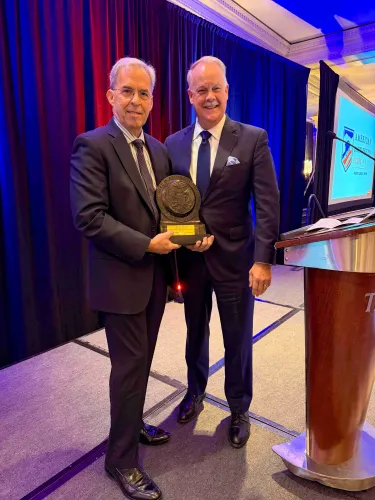
Trust President David Duncan presents the Trust's Prize for History Award to Rick Atkinson at the Grand Review in Philadelphia, Pennsylvania. Buddy Secor
Historian Will Durant once calculated that in three and a half millennia of recorded history there have only been 268 years during which there was not a war in progress, somewhere. Sadly, not one of those 268 years has unfolded during the lifetime of anyone in this building, or in this country, or on this planet. War is our lot, it’s where we live. It shapes our culture, our history, and our souls, individually and collectively. It shapes us to the extent that the scholar and World War II veteran J. Glenn Gray suggested that homo sapiens should perhaps be renamed homo furens, man the fighter.
John Updike wrote that World War II was the 20th century’s central myth. He called it “a vast imagining of a primal time when good and evil contended for the planet, a tale of Troy whose angles are infinite and whose central figures never fail to amaze us with their size, their theatricality, their sweep.” We don’t talk that way about the American Revolution of the 18th century, do we? As a tale of Troy, when good and evil contended for the planet?
Perhaps we should. There’s plenty of good and evil involved; the central figures are amazing; it was a global war, fought on four continents and the seven seas, with global implications felt to this day. And the angles are infinite. The British view, incidentally, was best expressed a century ago by Sir John Seeley, a distinguished historian at the University of Cambridge, who described the American Revolution as an embarrassing episode, quote, “which we have tacitly agreed to mention as seldom as we can.”
We’re well into our semiquincentennial, which sounds like a medical procedure but is actually the 250th anniversary of the nation’s founding. It’s an opportunity for celebration and commemoration, but also reflection about who we are, where we came from, what our forebears believed, and what they were willing to die for. That’s the most profound question any people can ask themselves.
It’s worth recalling that national memory of the American Revolution has ebbed and flowed over the past 250 years. Interest has waxed and waned and waxed again. In 1961, first lady Jacqueline Kennedy had wallpaper installed in the White House family dining room depicting battle scenes from the Revolution. Thirteen years later, just before the bicentennial, first lady Betty Ford ordered it removed because she found it, quote, “kind of depressing.”
For the past half century or so, historians and others have been at pains to remind you that those stirring sentiments from young Thomas Jefferson about all men being created equal and being endowed by their creator with certain unalienable rights, did not apply to 500,000 enslaved blacks—one in five of all souls living in the thirteen colonies when those fine words were written in 1776. Nor was it valid for native Americans, women, or indigents. In fact, the radical assertion that everyone is created equal was, for a long time, exceptionally awkward in some regions of the country. During Reconstruction in the 19th century, many if not most white southerners stopped observing the Fourth of July. In parts of the South, the holiday became exclusively a festival celebrated by black Americans.
The Founders have either been embalmed in reverence or condemned for their manifest shortcomings when, in truth, they’re much more complex than that, much more compelling, and, in that they all have feet of clay, much more like us. And frankly it starts with George Washington, proverbially and unarguably the indispensable man, notwithstanding that in his lifetime at Mount Vernon at least 577 enslaved blacks worked his plantation.
The novelist Thomas Mann said, “A writer is someone for whom writing is more difficult than it is for other people.” I’ve read that the French novelist Alexandre Dumas wrote The Three Musketeers and around 250 other books with help from his 73 assistants. I keep looking out the window at home in Washington, waiting for those 73 assistants to show up.
I write history because it’s an opportunity to write about character; it’s the human dilemma writ large.
And, as a military historian, I write about war because, as the Irish-born political philosopher Edmund Burke told us, “War is the matter that fills all history.” And, it’s about life and death, the heart of the matter. The novelist Cormac McCarthy once said, “If it doesn’t concern life and death, it’s not interesting.” I kinda agree. And war is a great revealer of character. The extravagant stress of combat refracts character, allowing you to see its basic components, in the same way a prism refracts light to reveal the inner spectrum.
Theodore Roosevelt once asserted that, quote, “The imaginative power demanded for a great historian is different from that demanded for a great poet, but it is no less marked. Such imaginative power is in no sense incompatible with minute accuracy…Very real and vivid presentation of the past can come only from one in whom the imaginative gift is strong.” That also sounds right to me. Although to quote that cracker-barrel philosopher, Huckleberry Finn: “If I’d a knowed what a trouble it was to make a book, I wouldn’t a-tackled it.”
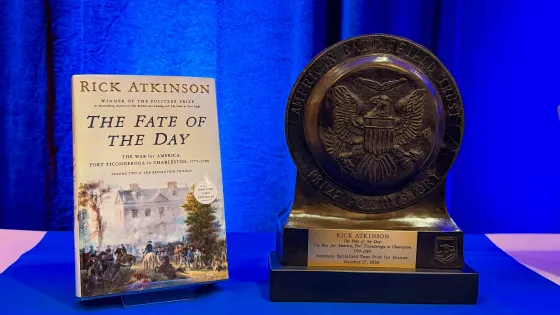
The 2026 American Battlefield Trust Book Prize for History Award is presented at the Trust's Grand Review in Philadelphia, Pennsylvania. Buddy Secor
What has a professional lifetime of writing about war taught me? Three things come to mind. The first has been called Allen’s Law, attributed to Frederick Lewis Allen, the longtime editor of Harper’s Magazine, who observed that, quote, “everything is more complicated than it appears to be.” That’s absolutely true when it comes to our national history, and we shouldn’t allow it to falsified through moronic simplification or historical mendacity just because it makes us feel better.
There’s a corollary to Allen’s Law specifically applicable to war. I’ll brashly call it Atkinson’s Law, and it states that war never goes the way the belligerents involved think it’s going to go. Never. Do you think that the war in Ukraine is going the way Putin expected? Or that the current war with Iran is going the way the folks in Washington who dreamed it up thought it was going to go? Go back to Thucydides and the Peloponnesian War. Never.
The second lesson is that in war, it’s usually the better team that wins, like the 60 nations who joined our alliance in World War II, the “united nations,” as Franklin Roosevelt called them. When our Revolution began in 1775, Britain had been alone since the end of the Seven Years’ War in 1763, and would remain alone. Having alienated her neighbors with overbearing commercial and military policies, she was utterly bereft of allies except for tiny Portugal, and even Lisbon threw her over. Think of that as we give a thumb in the eye to our closest friends today; we’re going to need them. During the Revolution, as the war expanded from North America to the wider world, Britain’s adversaries, including the French, the Spanish, and the Dutch, joined the struggle against her, with others providing material support to the Americans, including the Russians, Swedes, Danes, Austrians, Prussians, and others.
And the third lesson is that war is part of a terrible, sacred pact between generations. Edmund Burke believed that a nation’s development, including the wars that help shape that nation, becomes, as he puts it, “a partnership not only between those who are living, but between those who are living, those who are dead, and those who are yet to be born.” Osmar White, an Australian war correspondent in both the Pacific and in Europe during World War II, was more succinct when he wrote, “The living have the cause of the dead in trust.”
We have their cause in trust, starting with those who for eight years fought our first national war, the Revolution. That’s the core mission of the American Battlefield Trust. Moreover, the Founders’ overarching ambition was not just independence from British tyranny, as they defined it, but the prevention of future tyrannies. The prevention of future tyrannies. If we forget that, if we shrug it off, then we betray them.
In 1789, Benjamin Franklin died at the age of 84 in the house he owned on Market Street, here in Philadelphia. But a few months before he passed, he wrote in a letter to a friend, one of the lines for which he’s best remembered: “Our new Constitution is now established. Everything seems to promise it will be durable. But, in this world, nothing is certain except death and taxes.” What he’s telling us, virtually from the grave, is that there’s work to be done; the dream endures, but so does the struggle.
The American Revolution lasted 3,089 days, and the result was epochal and enduring—the creation of the American republic, among mankind’s most remarkable achievements. Some 90,000 more days have elapsed since then.
But America still remains predicated on an idea: that all men and women are created equal, that they’re endowed by their creator with certain inalienable rights, that among these are life, liberty, and the pursuit of happiness. That should act as a polestar for us, to provide True North, telling us what it is that we think we can do as a people. The perpetual challenge of the American experiment is to draw on these aspirational ideals, to make them our own, to hand them off to our children and our grandchildren, and to use that as a propulsion system for being the nation that those forebears thought we could become. Thank you so much for this extraordinary recognition.